As a follow-up post to this one here about communication nowadays, there was an article in Binah by someone who says she was as anti-cellphone as they come. Whatever advantages owning one had, they were outweighed by the disadvantages, as far as she was concerned.
But there was a price to pay, she says and she finally bought a cellphone. Why? Because the lack of communication was disturbing. Her friends and people she knows all text, and she missed out on more and more things that were important to her like meetings she attends that are arranged by text. By not texting, the organizer had to remember to call her (which is a bother) which she did not always do and not having a cell phone was putting the organizer out each month.
There were mazal tov texts that she never received, bris information she didn't get, and carpooling texts in which she wasn't included. "Not having a cellphone, I was separating myself from the klal, a klal that embraced texting as an easy mode of communication. Because like it or not, cellphone ownership (including texting) is a societal expectation."
She has since seen other advantages to owning a cellphone, though she says they are side benefits and not reason enough to own one. She now owns one "in order to stay connected with my family, friends and community. In my opinion, cellphone ownership and close relationships are only mutually exclusive if you allow them to be."
This supported what I wrote years ago, that I communicate more with people with modern technology. It may still be true that for young people, it stifles their communication. I'm not even sure that is true.
Interestingly, kosher phones in the US are filtered phones which may allow some Internet connection and texting, while kosher phones in Israel do not allow any Internet or texting. So what in America is called "kosher," in Israel is called "treif."
Showing posts with label communication. Show all posts
Showing posts with label communication. Show all posts
Feb 26, 2017


Jul 17, 2016
Artificial Communication?
In a chinuch article, the author responds to a question about cell phones for a high school student. He makes reference to the dangers of technology but his main point is children need to be fully present to develop connections with others. He says, "Cellphones are artificial connections. A real connection is a face to face conversation between two people and includes their facial and body language and their full attention."
I wonder what he would say about letter writing, writing letters to grandparents, as I did when I was a child and teenager and even older. What about penpals. What about letters to and from camp. Would he say that letter writing is an artificial connection?
I don't recall any condemnation of letter writing over the past decades, only praise. Was something lacking because there were no facial or body language? Yes. But did that make communication via letter artificial, i.e. fake?
What makes communication other than face to face talking artificial? It lacks what face to face conversations have, but that doesn't make it artificial. It can even be argued that sometimes things can be expressed in writing that cannot be said face to face, which would make writing superior sometimes.
I don't find it helpful when people condemn today's means of communication without acknowledging its positive aspects and when their arguments aren't consistent.
I wonder what he would say about letter writing, writing letters to grandparents, as I did when I was a child and teenager and even older. What about penpals. What about letters to and from camp. Would he say that letter writing is an artificial connection?
I don't recall any condemnation of letter writing over the past decades, only praise. Was something lacking because there were no facial or body language? Yes. But did that make communication via letter artificial, i.e. fake?
What makes communication other than face to face talking artificial? It lacks what face to face conversations have, but that doesn't make it artificial. It can even be argued that sometimes things can be expressed in writing that cannot be said face to face, which would make writing superior sometimes.
I don't find it helpful when people condemn today's means of communication without acknowledging its positive aspects and when their arguments aren't consistent.
Mar 27, 2016
Betrayal?
In a letter to the editor of Ami magazine, someone writes as follows:
"There are many other instances where people try to protect family members by acting in secrecy, with the result that their loved ones feel tremendously betrayed. This happens very often when the siblings of childless couples do not tell them when they are expecting a child in order to 'protect' them. These couples discover the information from outsiders and feel betrayed that they weren't told."
A number of things bother me about this paragraph.
One, of the three definitions in Merriam Webster, the one definition that remotely fits here is: to hurt (someone who trusts you, such as a friend or relative) by not giving help or by doing something morally wrong. Not providing pregnancy information is not a betrayal.
Two, if those who feel hurt that they were not informed know that the reason they were not informed was to protect them, it would seem that they should feel grateful to those who care about them.
Third, if childless couples feel hurt when not informed about impending simchas, that should happen only once. After that one time, they should make it clear that they would love to be informed of pregnancies so in case anyone wants to keep that information from them for their benefit, they will know that this is not what the childless couple wants.
Can we (frum society) get a grip?
Can we quit being hyper-sensitive and thinking people are betraying us when they mean well?
Can we let people know our likes and dislikes so they can please us, rather than "mortally wound" us with their well-meaning decisions?
"There are many other instances where people try to protect family members by acting in secrecy, with the result that their loved ones feel tremendously betrayed. This happens very often when the siblings of childless couples do not tell them when they are expecting a child in order to 'protect' them. These couples discover the information from outsiders and feel betrayed that they weren't told."
A number of things bother me about this paragraph.
One, of the three definitions in Merriam Webster, the one definition that remotely fits here is: to hurt (someone who trusts you, such as a friend or relative) by not giving help or by doing something morally wrong. Not providing pregnancy information is not a betrayal.
Two, if those who feel hurt that they were not informed know that the reason they were not informed was to protect them, it would seem that they should feel grateful to those who care about them.
Third, if childless couples feel hurt when not informed about impending simchas, that should happen only once. After that one time, they should make it clear that they would love to be informed of pregnancies so in case anyone wants to keep that information from them for their benefit, they will know that this is not what the childless couple wants.
Can we (frum society) get a grip?
Can we quit being hyper-sensitive and thinking people are betraying us when they mean well?
Can we let people know our likes and dislikes so they can please us, rather than "mortally wound" us with their well-meaning decisions?
Aug 21, 2015
The Ten Minute Rule

In the book Brain Rules, there is a section on attention. The author states, contrary to popular belief, we cannot successfully multi-task. Yes, we can do things like walk and talk at the same time, because neither activity requires much of our attention, or just the talking does. And yes, a pianist can play different notes with their right and left hands simultaneously; they are trained to do that.
But we cannot successfully work on a writing assignment while playing a computer game and listening to music and talking/texting. This is because we cannot do those thing simultaneously and so we keep going from one activity to the next, each time having to refocus our attention. More mistakes are made and it takes much longer to complete a task this way.
Even more interesting to me is his 10 minute rule. The most common mistake made by teachers-professors-lecturers is conveying too much information with not enough time to digest the material. Medina, the author, asks every college class he teaches: When do you start looking at the clock in a class of medium interest. The answer is 10 minutes. Medina developed a model for giving a lecture which goes like this:
Every lecture consists of 10 minute segments. Each segment covers a single core concept which is explainable in 1 minute. A 50 minute class would teach 5 large concepts. The other 9 minutes of each segment is used to discuss the core concept in detail. Each detail needs to be easily related back to the core concept, and the teacher needs to spell this out because you don't want the audience to have to multi-task.
When 10 minutes are up, the speaker needs to do something to gain another 10 minutes of the audience's attention. He calls them "hooks." Hooks need to trigger an emotion: fear, happiness, nostalgia, incredulity. They need to be relevant, not just a random joke. Hooks need to either relate to the previous material or introduce the next 10 minute segment.
Next time you listen to a shiur-lecture-class, notice how you react. Does your interest start waning after ten minutes? How do your favorite speakers (the ones who teach, not tell stories) hold your attention?
Jul 14, 2014
Answering the Questioner

R' Dovid Orlofsky gives an excellent talk here on the topic of how to respond to questions about Yiddishkeit. He makes some excellent points about communication and does so with his trademark humor which can be the laugh-out-loud type at times and excellent examples.
You should really watch the talk but in case you don't, or you want a summary of his points even if you do, here are some notes I took:
You don't teach subjects, you teach people.
You need the right answer for that person.
Some people have dedicated their lives to a question, they are so invested in the question that there is no answer for them like a Holocaust survivor who wants an explanation for the Holocaust.
Others, only a few, are truly interested in hearing an answer.
The rest, 95%, don't want to know the answer to questions they ask!
Ask "what do you mean" to clarify matters because people don't even know what they're asking!
We love to share information but s'yag l'chochma shtika, the less you say the better.
The hardest question to answer is the question you haven't answered for yourself.
People make statements, acknowledge it; they are not questions and there is no point in arguing with statements.
May 15, 2014
Think: How would I react if I was asked this question

Eliezer Krohn tells a story about his brother who was on a transatlantic flight. You are able to put items in the overhead bins or under the seat in front of you. The person sitting behind him had brought along a lot of food which he put under his brother's seat and he asked his brother, "Can you do me a favor and not sleep throughout the flight?'
Why did he ask him this? Because you are not supposed to sleep with food underneath the bed. Now, this was an 11-12 hour flight! His brother said, "I have a better idea. How about we keep it under your seat ...." The person said no, because then it would be hard to reach.
Can we imagine ever saying something comparable to this? We react with incredulity that someone could be so dense and insensitive, but as R' Krohn said, he's sure the person is not a bad person, but sometimes you need sechel and sometimes you are just so focused on yourself that you are oblivious to others.
Oct 11, 2013
Getting the Loving Message Across

Rabbi Noach Orlowek writes, "R' Yechiel Yakobson, one of Israel's revered educators, once met with a group of 'off the track' teenagers. He asked them how he could prevent what happened in their families happening in his own. They answered, 'You don't have to worry. Your children know you love them.'"
R' Orlowek then writes, "At a wedding in Milwaukee, I sat at the same table as Rav Michel Twersky, who grew up in Milwaukee 80 years ago and attended public school, since there were no yeshivos there at the time. I asked him how he and his brothers turned out to be such wonderful marbitzei Torah and paragons of Torah principles and Torah living. When I asked the question, his entire demeanor changed. Slowly and clearly, he said something that has never left me. 'We knew two things about our father, that he loved us very much and that he believed in us.'"
R' Orlowek goes on to point out that this is not to say that families where children have rebelled did not love their children. "But sometimes, the message that they love their children does not come through clearly."
One approach to getting the message across is by seeing which "love language" means the most to a child. Gary Chapman explained how he came to categorize five love languages, "Some of my encounters with couples through the years that brought me to realize that what makes one person feel loved does not necessarily make another person feel loved. For a number of years, I have been helping couples in the counseling office discover what their spouse desired in order to feel loved. Eventually, I began to see a pattern in their responses. Therefore, I decided to read the notes I had made over twelve years of counseling couples and ask myself the question, “When someone sat in my office and said, ‘I feel like my spouse doesn’t love me,’ what did they want?” Their answers fell into five categories. I later called them the five love languages."
It's simple and straightforward and worth looking up.
Nov 24, 2012
Talk to Me

It has become popular to decry the current state of affairs in which people don't communicate properly anymore. Articles have been written extolling old-fashioned verbal communication and bemoaning the fact that today, people no longer communicate in meaningful ways. Of course they are unhappy with the texts and emails that pass for communication these days. A variation on this theme is the complaint that people no longer write letters and how meaningful letter writing used to be, how people looked forward to receiving a letter and kept precious letters and how they are a valuable source of information of life long ago.
To respond to the first complaint, about verbal communication, well, letter writing has been around for millenia and people didn't complain about it! It was understood that written communications were sometimes the only way to communicate. They also have an advantage over verbal communication in that you can write a draft, review what you wrote, correct and refine it and then have the reader give it his full attention which is not as likely with verbal communication.
As to the complain that people no longer write letters, yes, with phone calls being so cheap and cell phone ubiquitous, kids and parents are not writing letters to one another when in camp and Eretz Yisrael, the way they used to. Then again, there were always those who were writers and those who weren't. The fact that phone calls are cheap won't stop a writer from keeping a diary, blog or writing emails.
When I said I have contacted people via email that I wouldn't otherwise be communicating with, someone said to me - that's because you used to write before the advent of emails. Those who are born to the email/texting/cell phone generation, are not as likely to write in meaningful ways. That might be true. But I think in other ways, we are more connected, knowing what is going on (sometimes more than I would like) with Jews all over the world through daily frum news sites. It's different these days, and like most things in life, there are advantages and disadvantages.
May 23, 2012
E-Books and E-Invitations

I've gotten so used to using Control-F to locate a word on a page that sometimes, when I read a book, I find myself wishing I can use that feature to find what I'm looking for.
Now there are E-books, Jewish ones too, and boy, does the description sound tempting. You can adjust the font and font size, you can do word and phrase searches, and you can mark important or favorite pages. Sounds great, but you can't use it on Shabbos and of course you have to pay for every book instead of being able to read it for free from the library.
But this means that sometime soon, E-books and Jewish E-books will become part of our life just as our computers are a major source of our reading material now. As someone in this transitional generation, between the Old Technology and the New, I find it all still most remarkable.
Another aspect of this transitional generation is the fact that we still snail mail invitations and even include a return envelope with a stamp when the percentage of people who mail them, don't justify their cost. Why don't we email invitations to all friends and relatives who have an email address? Well, we feel that it's just not the same as receiving a "real" invitation in the mail. That because all it entails is a click and no expense, that the recipients of e-invitations will be offended. Give it a few more years and that will change too.
Apr 10, 2012
Labeling

The society I live in would have me think that labeling people is bad. Well, from the Haggada we see that labeling people is not only acceptable; it's desirable.
If not for the Haggada's categorizations, I would think that labeling children or adults as wise, wicked, simple and unable to ask is unhelpful or even harmful. Yet, we learn that it's important to categorize people so that we know how to respond appropriately to them. We don't do ourselves a favor when we make believe that we are all equal. It doesn't mean that we need to address them using the words wise, wicked etc. but it does mean that in order to properly teach someone, we need to know who he is.
Feb 17, 2012
Is Criticism Ever Constructive?
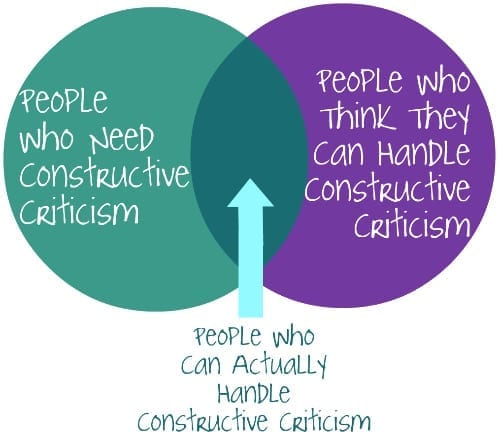
Is there such a thing as constructive criticism? I heard someone make a forceful case to say that no, there isn't, saying it's never welcome and is not productive and the "sandwich" approach, where you praise, then criticize, then praise is not helpful ("Do you think I'm a fool for not noticing?"). Yaakov waited till he was on his deathbed to rebuke his children. Moshe criticized the Jewish people only before his death and indirectly, with allusions.
Others disagreed. Some people express appreciation when their mistakes are pointed out. They don't want to repeat them! And even as it's uncomfortable to be on the receiving end of criticism, the question for the intellectually honest should be, "Is it true?"
And what about the mitzva to rebuke? And how can we do this mitzva when, long ago, the Gemara says (Erchin 16b) that our generation (meaning the time of the Gemara) no longer has anyone who can correctly deliver rebuke? Even more than that, there is no one in today's society who knows how to properly accept rebuke!
Apparently, the resolution lies in how the criticism is given, i.e. not as a personal attack, and not in a way that embarrasses the person. Refraining from constructively criticizing someone is safe, for no feelings are hurt, but ultimately, is silence an act of Ahavas Yisrael?
Jan 23, 2012
More Tzaros or the Same As Always?

One often hears discussions about whether there are more people dying young today, toddlers, children, teens, young adults, young marrieds, middle-aged marrieds who are diagnosed with cancer and other illnesses, in addition to "accidents" (car, fire, drowning), or not.
I am referring to the constant tzaros we hear and read about, the emails requesting Tehillim. The huge Tehillim lists. The ads and tzedaka requests for families that are suffering from tragedies.
So first, we have to decide what period of time we're comparing our times to! To life in Europe? To life in America?
1900-1950?
1950-1980?
the past 30 years?
Of course life expectancy has gone up and today we expect all live births to result in live adults when long ago (though not SO long ago), before vaccinations, many babies and children died! It was common for a woman to have many live births, let's say 13, but only have 5 survive childhood!
So I'm not talking about comparing our days to back then.
I'm more interested in knowing whether things have changed since say, the 1950's. I'm inclined to believe that it's because communications today are so advanced that we hear more than we used to. When a kalla was in a car accident or became seriously sick years ago, it was just a local issue, but now, people all over the world are hearing about many more tzaros through frum news websites and emails.
May we soon know of no more sorrow.
Dec 4, 2011
A Matter of Perspective

Yaakov is punished for hiding Deena from Eisav in parshas Vayishlach. When you consider that Shimon and Levi were 13 when they killed the city of Shechem and Dina was younger than them; and when you figure out that Eisav was almost 100 years old, you realize that the Torah's idea of marriage and a husband and wife having a "relationship" is far different than ours.
The most famous example of this is Rivka being 3 years old and Yitzchok 40 when they married. Yaakov was 84 when he married Leah and Rochel. The seemingly romantic scene when Yaakov kissed Rochel at the well occurred when Yaakov was 77.
Our modern, Western sensibilities look askance at "child brides," and yet, Jewish girls in Yemen and Morocco were often married by 11-12. The Chofetz Chaim married at 17. It was commonplace for Eastern European Jews to marry in their mid-teens.
We seem to think we have some sort of monopoly on what is "proper" and what isn't, what is a perversion and what isn't. Our views are colored by the culture we live in. We would do well to remember that.
Oct 27, 2011
More Than Happy
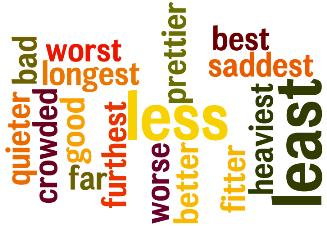
I've been noticing superlatives lately. Things like, "The bus is more than dependable." Hmmm. And if you merely said that it's dependable, why wouldn't that be enough to convey its reliability?
She said she's more than exhausted. Is being exhausted not expressing her tired she feels?
"I'd be more than willing to help." How much more than willing is that?
He said he's 1000% sure. And if he said 100% would that somehow convey that he's a bit uncertain?
Why have words become meaningless so that we have to pump them up to express what we mean?
Aug 12, 2011
Choosing to Disconnect

Many people have commented that this is what Shabbos accomplishes, but I think this initiative serves another purpose. As shomer Shabbos individuals, using technology is not an option. I think what R' Wallerstein is seeking to accomplish is to get people to set aside their preoccupation with their gadgets even when it halachically permissible to use them. He sees the great detriment of people not connecting with people in a personal, face-to-face way, throughout the week. He described standing behind someone at the checkout counter who was yapping away on her phone while the clerk rang up her purchases. Upon moving away from the counter and examining her receipt, she had questions which prompted her to go back and question the cashier. Because she hadn't been paying attention when she was being checked out, she caused the people behind her on the line to be delayed and prompted a nasty remark from the cashier. This is an example of what R' Wallerstein is talking about. Unplugging. Shutting the cell phone. Greeting people. Paying attention to people.
Although there have been people who spent hours on the phone, at least, up until recently, they were confined to their homes and the only people who suffered were their immediate family. Now, with mobile phones, the interruptions and rudeness are everywhere. I've been to a shiur when various phones have rung and been answered several times over the course of an hour. That's inconsiderate to the speaker and other participants. Checking messages and ringing phones in shul, at the Kosel, at weddings and funerals are further invasions.
R' Wallerstein's point is "connection." I think an equally important goal is discipline. To ensure that our technology serves us and is not our master.
Jun 30, 2010
Talk About Miscommunication!

As all children yearn for their parents' approval, he worked on getting his mother to love him by buying her gifts and in other ways showing his devotion to her but his feeling unappreciated stayed with him for decades. About fifty years after the war, in which his mother was murdered, was over, he went over to his sister at a wedding to wish her mazal tov and she introduced him to a woman sitting next to her as "the best Katz in the family" and added, "My mother positively adored him."
The author was shocked at this statement and protested - but she always said that proverb about goodness being reflected in the face and you know that my face was never anything to write home about! The lady sitting next to his sister, who understood the Hungarian saying, insisted that those words were a tremendous compliment. "They are the nicest words a child can hear," she said.
This enabled him to think that perhaps his mother had really liked him and had really meant what she said.
Some time later he had occasion to meet the Hungarian ambassador to the United States. He decided he would take the opportunity to clarify, once and for all, the meaning of the words his mother constantly said to him. He wrote the proverb down in Hungarian and asked the ambassador to translate it for him. The ambassador said, "This saying is the nicest, warmest thing a parent can say to a child." He unburdened himself to the man and said how he always thought his mother didn't like him and how much he had suffered because of it. The ambassador said, "You can rest assured that your mother loved you more than any of your brothers and sisters, and the proof is that she said this to you often."
Is this not extraordinary? A mother expresses her deep love for her child and the child, rather than basking in her love, feels hurt and unappreciated! How many times do we misunderstand what people are saying to us? What feelings do we have towards people that are based on a completely erroneous understanding of what they said to us? Let us pray that it does not take us decades to appreciate the truly warm feelings people have for us.
Jan 14, 2010
Entitled to Speak?

People show an overwhelming need to express themselves and hear others express themselves
Everything can be said ...
These are very recent sentiments in our secular and Jewish societies.
Up until very recently the world (including Jews) raised children on the principle of "children should be seen and not heard." Even when children grew up, they knew that their opinions were not to be voiced, that parents and authority figures had the final word, sometimes the only word.
People had a more of a sense of knowing their place and wouldn't dream that their opinion was on a par with that of a learned person and that they had any sort of "right" to speak up before their elders.
Today, online, everybody can comment about anything they please. Not that long ago, your only recourse was to write a letter to the editor and it might be printed. If you called a radio program, you might be heard.
What does the Torah have to say about this?
- Lavan is called a rasha for speaking up before his father Besuel.
- Regarding the sale of Yosef, Rashi 49:4 says that Yissocher and Zevulun, the children of Leah, would not speak up before their older brothers.
- The laws of Kibud Av V'Eim including an older brother because the mitzva is for the purpose of instilling us with respect for authority which ultimately leads us to respect G-d's authority.
- When the judges of the Sanhedrin stated an opinion they did so from the least important to the most important so that it didn't end up with the least important among them rubberstamping the leader's psak.
***
Who am I to bring up this topic when I started this blog to express my view and I welcome your input? Good question!
Subscribe to:
Comments (Atom)

 Posts
Posts

