Showing posts with label Kibud Av v'Eim. Show all posts

Feb 9, 2015

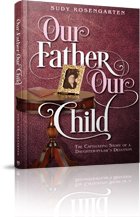
Our Father Our Child


I just read Our Father Our Child by Sudy Rosengarten. It was a poignant read.  She tells about her father-in-law, a G-d fearing, fervent Chassid who raised seven Chassidishe children in Toronto before there was any Jewish schooling there, quite a miracle.
 
He and his wife eventually move to Eretz Yisrael and Mrs. Rosengarten and her husband move there too, so her in-laws will have children near them.  Time passes, children are born, grandchildren marry and live in Eretz Yisrael.  Her mother-in-law dies and the book tells about how Mrs. Rosengarten and the extended family do their utmost to care for their partriarch.
 
There are parts to cry over and one very funny chapter to laugh over.  It's inspiring to read of a staunch Yid whose service of Hashem was with such a tmimus and simplicity.  And it's moving to read how the family admires him, loves him, and rallies round him.  It's sad to read about how he eventually ails and suffers.
 
The title of the book is a bit disturbing (see previous post) since referring to him as a child does not sound all that respectful.  It is true that eventually his needs are looked after as one looks after a child, and it is also true that it sounds like they had the utmost respect for him.  The title could have been better.  And the subtitle about the devotion of a daughter-in-law was unnecessary.  Although the author's devotion comes across clearly, the book is not about her.
 
All in all, I would recommend the book, both for the description of a fiery servant of Hashem, for the love of Yiddishkeit that comes across, and for the description of how a family devotedly took care of their father/father-in-law/grandfather.

Jun 22, 2014

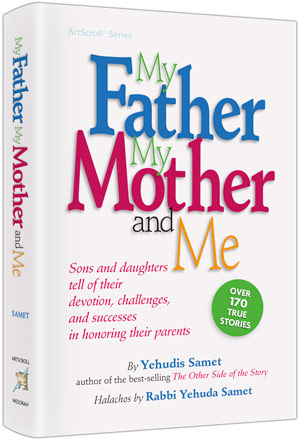
My Father, My Mother and Me

Highly recommended reading is Rebbetzin Samet's, My Father, My Mother, and Me (Artscroll).  In the format she used in her first excellent book, on the topic of judging others favorably,
she intersperses the halachos with terrific, true stories on the subject.  Her second book, on the same subject of judging favorably, consisted entirely of true stories:

Feb 17, 2014

You Don't Analyze Parents!


I was reading an interview of the daughter of R' Baruch Sorotzkin z'l about her father when a paragraph struck me.  The daughter was describing the parent-child relationship and said, "I could never utter a word that resembled 'no' to my father.  My parents commanded respect without saying anything.  It was the atmosphere in the house."

She said that along with the tremendous awe and respect there was also great love between parents and children.  However, this love manifested not in a palsy-walsy kind of way that many parents cultivate with their children nowadays.

Then the paragraph: "I remember once hearing someone I know claiming that she has a certain problem because of something having to do with the way her mother raised her.  I was taken aback.  Analyzing your mother? You're upset because your parents didn't do something right? In our upbringing, this was unheard of.  I once mentioned to my aunt that I think I have a certain midda from my mother.  My aunt responded with mussar, telling me, 'You don't analyze parents!'"

Dec 28, 2012

Shulchan Aruch versus Psychology


Rabbi Binyomin Ginsberg from Minnesota, a longtime teacher and principal was speaking to parents and someone asked "How can we get our children to behave?"

His response: "When you walk into the room, do your children stand up for you?

The parent said no.

R' Ginsberg concluded, "So, what do you want?!"

Can you imagine a child psychologist saying that?

Dec 3, 2009

Obedience

I just finished reading a book written by the Duggars, a Christian couple who are expecting their 19th child in March.  I found their description of how they teach their children obedience quite interesting.  It sounds like an old-fashioned word, obedience, because it goes against the American values of independence, democracy, freedom to do and say as you please.  It was quite refreshing to read about this!

The Duggars teach why obedience is so important.  In teaching their children to obey their parents they are also teaching them to listen to G-d.  Their goal is to get their children to understand:

1) to obey instantly because if they don't listen immediately it's not obedience

2) to obey cheerfully - they say G-d wants us to obey Him joyfully and parents want the same thing from their children

3) to carry out whatever they are told thoroughly, completely

4) to listen unconditionally, without arguing

I don't think frum parents want to hear "Yes, ma'am" when they tell their children to do something, but since we are enjoined to learn from everyone, I think we can take a lesson from the Duggars about teaching obedience.  For we say that the reason we have a mitzva of Kibud Av v'Eim, honoring our parents, is that we honor Hashem.  If we disrespect our parents' authority, we will end up disrespecting Hashem's authority.