I heard an interesting thought from Rabbi Aharon Dovid Gancz of Monsey. Someone he was mekarev told him about a problem he had. The mekurav's father kept kosher to a minimum standard and this son of his felt he could not trust his kashrus. His father was upset. How dare his son not trust him, and was his son holier than him, and why did his son have to keep a higher standard, wasn't his standard good enough?
R' Gancz asked him, would your father understand if I did not eat in his house? The man said sure, you are a rabbi. So R' Gancz said, the problem then is, that you are not a rabbi. Don't blame your father!
R' Gancz says he uses this concept often, in tznius for example. We need to be so inculcated with the midda and mindset of tznius that nobody would dare behave or dress otherwise in our presence; they would feel uncomfortable to do so. He calls for "raising the bar" in all areas.
It has been noted that the same people who seemingly have no qualms about dressing inappropriately among other religious Jews, would behave respectfully if they were invited to the home of Japanese who asked them to remove their shoes. Why is this so? I think R' Gancz has the answer. The Japanese set a tone which most people would be loathe to violate. Also, as guests, they would not want to insult their hosts. Amongst ourselves though, we feel like the brothers and sisters which we are, and "Don't tell me what to do!"
Showing posts with label spiritual levels. Show all posts
Showing posts with label spiritual levels. Show all posts
Jun 10, 2014


Mar 25, 2014
A Momentary High?

Eytan Kobre raised an interesting point in one of his Mishpacha articles. His daughter was going to attend one of those inspirational programs with a lineup of popular speakers. Even as she was looking forward to attending, she said she wondered whether the experience would be one in which she would go to lecture after lecture and end up by feeling inspired without any concrete results.
That's a provocative point to ponder for those who attend or listen to shiur after shiur and/or read one inspiring book and article after another. Speaking for myself, I ooh and ahh over powerful messages, new ideas, touching stories and moving biographies, but then what?
Kobre goes on to refer to the famous episode in which the Chofetz Chaim exorcised a dybbuk from someone possessed of it, a story that his talmid, R' Elchanan Wasserman repeated annually on Purim (or parshas Zachor). Kobre wrote that a talmid of Radin, later a rav in the Bronx, was a witness to that dybbuk incident. Years later he said, "Do you think being present at that awesome moment had a lasting effect on me? For two weeks afterward I behaved like a malach (angel) and then, I went right back to the way I'd been before." Pointing to the wall he said, "It had an effect on me like it had on this wall."
Likewise, Kobre wondered what effect remains two weeks after hearing an inspirational talk. His questions are:
Do inspirational talks never help foster changes in people's lives? He says, surely that is not so. But the question is what approach, given limited time and energy to devote to personal growth, is most likely to help one succeed?
to be continued
Oct 2, 2013
Who Am I? part 2

continued from previous post
The article continues with the story of a girl from a wealthy neighborhood going to seminary in Eretz Yisrael and being amazed by the simplicity and purity of the kollel families there. Over her year in Israel she heard about the idea of a woman supporting her husband as he learned. She decided that this is what she wants. She knew she couldn't manage for more than five years, but she was excited about this prospect.
Then she returned home and went back to life as she always knew it. She thought about all the things she would be unable to have if she lived a kollel life. She wanted a Torah home but wondered how she could support a family.
She consulted with rabbis, kollel wives, teachers, etc. and received a variety of comments, some of which supported her lofty goal and some of which knocked it.
"I didn't know what to think. Was I just on a seminary high? How could it be that I was so sure about something a short while ago, yet now I was so tormented? Which was the real me? Am I the girl who really needs all these luxuries, all this money, all this stability and practicality .. making my seminary decision just a hasty, foolish, idealistic thought? Or am I really the seminary girl who 'saw the light,' and felts as if kollel was the right lifestyle to live, and I am just hesitating now because I'm back home?"
She concluded that a kollel lifestyle was not for her and turned down shidduchim suggestions with wanna-be longtime learners. She wanted her husband to learn during their first year of marriage and take it from there.
Oct 1, 2013
Who Am I?
.jpeg)
continued from previous post
I read an article by Malka Weisman about a girl with well-educated parents who herself was an ambitious student. She had her sights set on an Ivy League college. She worked hard and scored high on the SAT's in order to have a chance at winning an academic scholarship to a very expensive school. She won the scholarship but her parents were still faced with hundreds of thousands of dollars to pay which they couldn't afford. She took the SAT's again to get an even higher score and did all she could to achieve her goal. In the meantime, she prepared to go to seminary in Israel.
She went to Israel and loved it and her classes. But when she heard ideas that contradicted her secular educational goals, she chafed. As time went on, she began to wonder whether her plan of attending a secular university was a good one for a bas Yisrael.
During Pesach vacation she received the exciting news that she had been awarded a full scholarship, but at that point, she wasn't that sure she wanted to attend it any more. It was a wrenching decision, made after much agonizing, but she gave up the scholarship and decided to go to a program attended by frum girls.
Then she went back to the US and began to feel regrets over her decision. People told her she had been brainwashed but she said nobody forced her to make this sacrifice. She made it because she believed it was the right thing to do.
"And I wonder, throughout all this, if I was really me when I made that decision. 'Me' is the academic girl who values education, who doesn't settle for anything less than the best. 'Me' is the girl who was accepted into the university of her dreams. Who was the strange entity who 'changed her mind? If that was me, then who am I? Am I the person who was so excited to get accepted to my dream school, or the inspired seminary girl focused on the one, true, straight, Torah path in life? This is my identity crisis. Which person am I?"
Sep 30, 2013
The Seminary High

A woman whose daughter went to seminary in Israel for a year, said she wants her daughter to have six months back home before dating so she can see who she really is and not date from a "seminary high."
That got me thinking. Why does this mother think that the "real" person is the one who comes down from her inspiration? Maybe the inspired person is the real person? How are we defining real?
An analogy, you go to an event or shiur and are inspired by the speaker. Is that real or not? You know how when are you excited by what you heard, you want to tell people about it? Would it be a good idea to wait a week or a month before telling anyone so the inspiration will wear off and the real you will be back? I don't think so ...
But I do understand where that mother is coming from. It's one thing to sit in a classroom, having all expenses paid for, usually by one's parents, and being inspired to marry a ben Torah and enable him to learn for years to come. Actually being married and living that life is another thing. So the mother figures that six months down the road, reality will set in. If the girl still feels strongly about her religious undertakings and ambitions, she will say so and date accordingly (though even then, it's not like actually being married). But to date while on a high can be a dangerous proposition because you can end up married based on idealistic commitments that are not as desirable as time goes on.
R' Avigdor Miller z'l felt otherwise. He said a girl should go from graduation to the chuppa for precisely that reason. She is idealistic and should marry in that state and it will uplift her future life.
Aug 27, 2013
Different Reactions

Someone I know had a dream about the Arizal, in which she was told to say Nishmas and the Pitum Ha'Ketores until Ana B'Koach, and then to say it backward. When I heard this being discussed and whether a rav should be consulted about others saying it too, my reaction was: She had the dream, so she can say it. What does it have to do with anyone else?
I have enough to say without someone sharing dream instructions with additional things to say! It struck me though, when I heard someone else's completely different reaction. As this person said, "My gut feeling ..." in my mind I finished the thought, "In my gut feeling, the dream was for her," but the thought was ended quite differently. "My gut feeling is, if someone asks that verses be said, if I had the discipline and time to do it, of course I would like to help."
Well! How jarring and illuminating to encounter a response that was entirely different than my own. Although I think my reaction is valid, I am still impressed by the willingness to make this commitment, even if it is only wishful.
Aug 23, 2013
The Power of Expectations

Sara Rigler wrote an intriguing article in the May issue of Ami magazine. She said that Rebbetzin Kramer, the subject of a book that she wrote, see here, would call newly religious women who visited her "tzadekes." At first, she thought her naïve but as she got to know her, she saw that Reb. Kramer could not be fooled.
She concluded that the rebbetzin's motivation was to convince people that they could actually become a tzadekes. She saw it in them.
Sara Rigler goes on to relate a story about how she realized her 15 year old son was in the wrong yeshiva when his rebbi did not see him in a good light. If his rebbi did not view him favorably, he could not guide her son to becoming great. She concludes, "The lesson the rebbetzin taught me [is] that the people in your life become the vision you hold of them ..."
She then tells two marriage stories. She met two women who had married serious learning boys and had been kollel wives until their husbands announced they were no longer believers.
One wife divorced. Ten years later, her anti-religious husband is a terrible influence on their children.
The other wife considered divorce but then read something that convinced her that it wasn't a good idea. She decided that she would make it the best marriage she could and that this entailed respecting her husband. This wife believed in her husband, thanked him for what he did, complimented him in front of the children for how he cared for his father and ignored what he did wrong. Ten years later, he did not return to what he once was but he was going to shul daily and learning Torah every day. Remarkable woman!
Jun 21, 2013
May 3, 2013
Thoughts Affect the Items we Use or Make

continued from the previous two posts
The following are other examples I've come across:
* There's a story about an innkeeper who spilled out the vodka several times before serving it because he didn't want to serve it until his intentions were good (so that the drink wouldn't be adversely affected)
* We choose a sofer who is a yirei shomayim because the level of the sofer affects the spiritual quality of the tefillin etc. he writes.
* There's a story about the Baal Shem Tov in which he knew that the chazzan had distracting thoughts because the man who made the Shevisi sign was wicked and did not have holy thoughts when he made it but was playing with a dog.
* When the Baal Shem Tov saw a crafted object, he knew the thoughts behind it because the craftsman leaves the imprint of his intelligence, which is his life force, in the object he makes.
* Haman wanted timber from the teiva where the Shechina had dwelled.
Jan 30, 2013
Climbing towards Kabbolas Ha'Torah
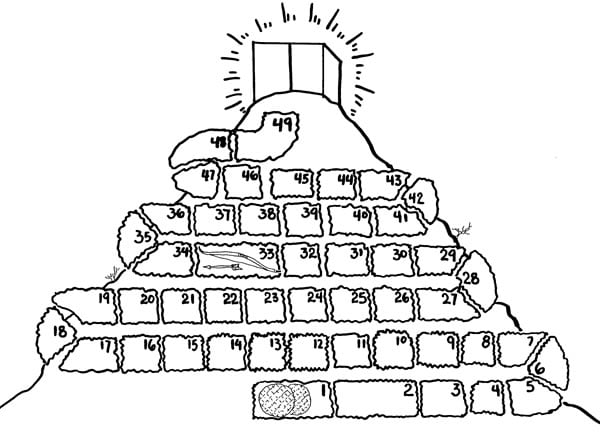
The Jewish people were on the 49th level of impurity in Egypt. Then they were taken out of Egypt and they prepared for 49 days in order to receive the Torah. We commemorate this by counting the 49 day period between Pesach and Shavuos.
So the question I have this year, on the parsha, is - what about those days when they complained about the manna, about not having water, about bitter water? Those were part of the 49 days. Did they elevate themselves out of impurity on the very days that the provoked Hashem?
I've asked this question here and there and the answers I've heard haven't been satisfying. One said, it was the eirav rav. Another one said that it is the nature of a nisayon to elevate a person as a nes-flag waves on high. Still another said that is how we grow, we move forward and slip backward. But these were 49 days of continuous growth! True, Rashi says they did teshuva when they left Refidim, but what about their other complaints? And if it was just the eirav rav, I don't think the mishna in Avos would refer to the ten times we tested G-d.
So if you have anything to offer, go ahead and post a comment.
Jul 1, 2010
That's A Madreiga ...

But is this so or is it a cop-out? Is it a genuine protest that this is just not for us, or is it a defense mechanism in which something special - an outlook or an action - is dismissed so we are not obligated to do the same?
Here is how I understand when something is actually a madreiga: Someone is inspired by a story about a doctor who saved a life and decide they want to emulate him. Can they start practicing medicine then and there? Of course not! They have to go to college, medical school, do an internship, residency ... There are steps (madreigos) needed to achieve the goal.
True, often the inspiring stories and ideas that we hear and read are about extraordinary people who did work step by step in their avodas Hashem, in their davening, on their middos, over the course of many years and consequently achieved great things. But when we hear these stories we can still think about what we can take from the story, what we can emulate in our less rarified lives. And today, with the numerous books and magazines and online stories about all sorts of people doing special things, not just tzaddikim and great rebbetzins, we can't really fall back on the ol' madreiga excuse, can we ...
Subscribe to:
Posts (Atom)

 Posts
Posts


