The Chofetz Chaim zt"l
Eytan Kobre raised an interesting point in one of his Mishpacha articles. His daughter was going to attend one of those inspirational programs with a lineup of popular speakers. Even as she was looking forward to attending, she said she wondered whether the experience would be one in which she would go to lecture after lecture and end up by feeling inspired without any concrete results.
That's a provocative point to ponder for those who attend or listen to shiur after shiur and/or read one inspiring book and article after another. Speaking for myself, I ooh and ahh over powerful messages, new ideas, touching stories and moving biographies, but then what?
Kobre goes on to refer to the famous episode in which the Chofetz Chaim exorcised a dybbuk from someone possessed of it, a story that his talmid, R' Elchanan Wasserman repeated annually on Purim (or parshas Zachor). Kobre wrote that a talmid of Radin, later a rav in the Bronx, was a witness to that dybbuk incident. Years later he said, "Do you think being present at that awesome moment had a lasting effect on me? For two weeks afterward I behaved like a malach (angel) and then, I went right back to the way I'd been before." Pointing to the wall he said, "It had an effect on me like it had on this wall."
Likewise, Kobre wondered what effect remains two weeks after hearing an inspirational talk. His questions are:
Do inspirational talks never help foster changes in people's lives? He says, surely that is not so. But the question is what approach, given limited time and energy to devote to personal growth, is most likely to help one succeed?
to be continued
Showing posts with label Chofetz Chaim. Show all posts
Mar 25, 2014
Nov 17, 2013
Consider Yourselves Warned
I've been thinking intermittently about the disaster in the Philippines. Major loss of life, misery and devastation. How everything that happens in the world happens for the sake of the Jewish people. The following was written by R' Mendel Weinbach a'h:
When news of an earthquake in Japan a century ago reached the Radin Yeshiva in Poland, the sainted Chofetz Chaim assembled the students and delivered an inspiring mussar lecture.
This lesson was delivered millennia ago by the Prophet Tzephaniah who declared in the Name of G-d:
"I have cut off nations; their pinnacles are desolate; I have made their streets waste so that none passes by; their cities are destroyed so that there is no man, there is no inhabitant. I said, surely you will fear me and will learn a lesson." (3:6-7)
The words of the Prophet are quoted in a lecture written during the Middle Ages by the great Talmudic commentator Rabbeinu Nissim who points out that when people fail to learn from the disasters which strike others, they cause such tragedy to come closer to them. One who fails to see natural disasters as a Heavenly warning and fails to make any improvements, he concludes, is comparable to one who has sinned after being warned and thus exposes himself to retribution.
I have a hard time with this, specifically with the making improvements part. I get as far as remembering everything that transpires happens for our sake and that they are supposed to be calls to teshuva. I wonder if others are more successful in taking this to heart.
Oct 29, 2011
Is It True?
"Fiction can often be the best vehicle for helping us see our behavior objectively and pinpoint our mistakes, especially when it's written with true-to-life characters that are easy to identify with."
This is why mashalim (parables, fables) have long been used by Torah sages. The most famous are in the book of Mishlei by Shlomo Ha'Melech and many years later, the parables of the Dubna Maggid and the Chofetz Chaim.
However, when contemporary Jewish authors think that their novels and short stories, works of fiction, will change the world, I think they're deluding themselves as to the importance of their work. Frum novels, by and large, are for the purpose of kosher entertainment.
I was surprised when, in a discussion about fiction and non-fiction in frum publications, the person I was talking to did not particularly care whether the writing was true or not. I maintain that just as I have no reason to empathize with make-believe characters, I have no reason to be inspired by characters that are the figment of an author's imagination. When a real person does something heroic, that can be moving and inspiring. Why would I want to read about fictional people in the Holocaust, for example? What impact can imaginary characters who do extraordinary acts of chesed or kiddush Hashem have on me? None.
The parables used by maggidim were tools meant to highlight our foibles in a way that slips under our defensive radar. The parable Nosson the Navi told Dovid Ha'Melech enabled Dovid to see his error when a direct confrontation would not have worked. It's important to differentiate between the parable as a tool for improving middos as opposed to a work of fiction that is not primarily a teaching tool.
Dec 9, 2009
Promoting Shabbos and Tznius
Rabbi Matisyahu Salomon makes an interesting observation. He says that nowadays, whenever some calamity happens, people are quick to lay the blame on deficiencies in shemiras ha'lashon (I would add the related sin of lack of Ahavas Yisrael and machlokes), but if you look into the collected letters of the Chofetz Chaim where he refers to many disasters (pogroms, fires, poverty, communism) he never connects them to shemiras ha'lashon! Usually, he lays the blame on the lack of Shabbos observance and tznius. Occasionally, he also mentions bittul Torah and poor tefilla, but never shemiras ha'lashon.
The problem as I see it is, shemiras ha'lashon is something that applies equally to men and women, so when we are urged to improve in this area, nobody feels uncomfortable. The same would also apply to Shabbos observance. But if people try to promote tznius and point out failings in tznius, the response is often negative since women don't want to be made to feel that the problems we face are their fault. You can't help but elicit a defensive reaction when you point a finger at a sub-group.
So what's the solution? Well, for one thing, to promote greater Shabbos observance. There are certainly plenty of books available in so many different formats on the subject of Shabbos. Some favorites of mine are: Baruch Chait's terrific book on the 39 Melachos:
http://www.feldheim.com/cgi-bin/category.cgi?item=0-87306-586-7
"Shabbos Secrets" for inspiration:
http://www.israelbookshoppublications.com/ProductDetail.asp?PID=360
and there's "Shemiras Shabbos K'Hilchasa" for practical guidance in Shabbos observance:
http://www.feldheim.com/cgi-bin/category.cgi?item=1-58330-494-0
As for promoting greater tznius, that's a tough one because it seems that those who are already doing well in this area are the ones who show up for the Kinusim on the subject. Maybe an avenue that should be pushed more is lecturing men on the subject of tznius with a particular emphasis on urging them to encourage their wives and daughters to dress according to halacha and in an aidel manner. Too many husbands either tacitly allow or actively urge their wives to dress inappropriately. And who is paying for their daughters' clothing? Parents should be encouraged to put their foot down and not allow purchases of inappropriate clothing.
Other suggestions? Post your comment! :)
Labels:
Chofetz Chaim,
hashkafa,
Rabbi Salomon,
Shabbos,
shemiras ha'lashon,
tznius
Nov 29, 2009
Don't despair!
I read the following on Revach.net
As told by Rav Refoel Salzer of Gateshead of Gateshead
Approximately 17 years ago, I taught a class of 12-year old boys for Chumash-Rashi. One particular boy in the class (we’ll call him “Reuven”) gave me cause for concern. I knew him to be a serious, hard working boy with excellent ability, and I expected him to be at least among the top of the class. It alarmed me therefore to note that he was scoring around the 40% mark, week after week. His Gemara Rebbi confirmed that in his class, Reuven was at the head of the class.
I took Reuven aside and questioned him. I was even more astounded by his explanation. “Rebbi,” he said in all honesty and sincerity, “ this has been going on for years! I have just never been able to ‘get my teeth’ into Chumash Rashi. There’s just something about it that does not let us get on!” He then went on to assure me that it had nothing to do with the Rebbi – it had been the same with all his past Rebbeim. When I tried telling him how fundamental Chumash Rashi was to his Yiras Shomayim and the success of all his learning, he replied that he was fully aware of all this, - but he simply could not get to grips with this crucial Limud.
This left me absolutely dumbfounded – I could not understand why such a solid, ‘tachshit’ of a boy should have such difficulty. He was clearly talking from the heart, and I found myself helpless in a inexplicable situation.
That night I attended a wedding which was graced by Harav Matisyohu Salomon. He had just returned from a visit to the then Soviet Union, and he related a ‘vort’ he was told there by an ‘elterre Yid’ who had heard it from the Chofetz Chaim!
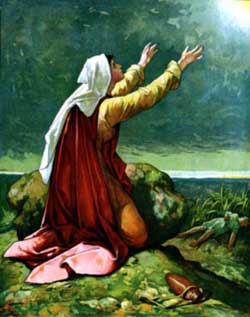
In Parshas Vayera, when Hagar took the ailing Yishmael through the desert where she ran out of water, Chazal tell us that the well of water she discovered later, was actually there all the time. Hagar however was prevented from being able to see the water until after her encounter with the Malach.
Why, asks the Chafetz Chaim, did Hashem hide the water from her in the first place? If nature would have been allowed to run as normal, there would have been no crisis to begin with. Furthermore, if we examine the pesukim, we see (פרק כ"א פסוק י"ז) that Hashem had decided that Yishmael should be allowed to live כי שמע א...ם את קול הנער באשר הוא שם (Hashem has heard the voice of the boy where he is at now). It is only in פסוק י"ט that Hagar is able to ‘discover’ the well of water. In between these two pesukim is an entire possuk קומי שאי את הנער והחזיקי את ידך בו כי לגוי גדול אשימנו (get up and lift the boy and support him for I will make him into a great nation). It appears that Hagar needed to go through this process of lifting and grasping her son before she was to be released from her torment. What is the meaning behind all of this?
The words of Harav Salomon almost knocked me off my seat. The Chafetz Chaim explains that the reason why Hagar lost the ability to locate the natural supply of water – was a result of her having despaired and having “written off” Yishmael’s chances of survival. In fact, we are being taught here that when a person despairs and does not believe in his own ability, his attitude becomes a self-fulfilling prophecy and Hashem removes the ability that he actually had!
Even after the Divine ‘psak’ that Yishmael should live, Hagar was still deprived of the water supply. The only way to change the situation was for her to change her attitude! She had to lift the child, hold him tight and have faith in him that he will indeed grow into a great nation. Once this was done, Hashem reversed the situation to its original natural state, and Hagar could partake of the resource that was waiting for her all along.
Suddenly everything made sense! Reuven’s success was being withheld from him because of his misguided perception of his ability. If only he would lift himself up and take a firm grip of himself, he would be allowed to grow as he so badly desired.
The following day, I decided to share this vort with the entire class I did not even make eye-contact with Reuven when I said this over but I fervently hoped that he would get the message.
To this day I cannot be certain whether this made a difference, but I do know that from that week onward, Reuven (who is now a Magid Shiur) began to achieve increasingly better grades at Chumash Rashi.
As told by Rav Refoel Salzer of Gateshead of Gateshead
Approximately 17 years ago, I taught a class of 12-year old boys for Chumash-Rashi. One particular boy in the class (we’ll call him “Reuven”) gave me cause for concern. I knew him to be a serious, hard working boy with excellent ability, and I expected him to be at least among the top of the class. It alarmed me therefore to note that he was scoring around the 40% mark, week after week. His Gemara Rebbi confirmed that in his class, Reuven was at the head of the class.
I took Reuven aside and questioned him. I was even more astounded by his explanation. “Rebbi,” he said in all honesty and sincerity, “ this has been going on for years! I have just never been able to ‘get my teeth’ into Chumash Rashi. There’s just something about it that does not let us get on!” He then went on to assure me that it had nothing to do with the Rebbi – it had been the same with all his past Rebbeim. When I tried telling him how fundamental Chumash Rashi was to his Yiras Shomayim and the success of all his learning, he replied that he was fully aware of all this, - but he simply could not get to grips with this crucial Limud.
This left me absolutely dumbfounded – I could not understand why such a solid, ‘tachshit’ of a boy should have such difficulty. He was clearly talking from the heart, and I found myself helpless in a inexplicable situation.
That night I attended a wedding which was graced by Harav Matisyohu Salomon. He had just returned from a visit to the then Soviet Union, and he related a ‘vort’ he was told there by an ‘elterre Yid’ who had heard it from the Chofetz Chaim!
In Parshas Vayera, when Hagar took the ailing Yishmael through the desert where she ran out of water, Chazal tell us that the well of water she discovered later, was actually there all the time. Hagar however was prevented from being able to see the water until after her encounter with the Malach.
Why, asks the Chafetz Chaim, did Hashem hide the water from her in the first place? If nature would have been allowed to run as normal, there would have been no crisis to begin with. Furthermore, if we examine the pesukim, we see (פרק כ"א פסוק י"ז) that Hashem had decided that Yishmael should be allowed to live כי שמע א...ם את קול הנער באשר הוא שם (Hashem has heard the voice of the boy where he is at now). It is only in פסוק י"ט that Hagar is able to ‘discover’ the well of water. In between these two pesukim is an entire possuk קומי שאי את הנער והחזיקי את ידך בו כי לגוי גדול אשימנו (get up and lift the boy and support him for I will make him into a great nation). It appears that Hagar needed to go through this process of lifting and grasping her son before she was to be released from her torment. What is the meaning behind all of this?
The words of Harav Salomon almost knocked me off my seat. The Chafetz Chaim explains that the reason why Hagar lost the ability to locate the natural supply of water – was a result of her having despaired and having “written off” Yishmael’s chances of survival. In fact, we are being taught here that when a person despairs and does not believe in his own ability, his attitude becomes a self-fulfilling prophecy and Hashem removes the ability that he actually had!
Even after the Divine ‘psak’ that Yishmael should live, Hagar was still deprived of the water supply. The only way to change the situation was for her to change her attitude! She had to lift the child, hold him tight and have faith in him that he will indeed grow into a great nation. Once this was done, Hashem reversed the situation to its original natural state, and Hagar could partake of the resource that was waiting for her all along.
Suddenly everything made sense! Reuven’s success was being withheld from him because of his misguided perception of his ability. If only he would lift himself up and take a firm grip of himself, he would be allowed to grow as he so badly desired.
The following day, I decided to share this vort with the entire class I did not even make eye-contact with Reuven when I said this over but I fervently hoped that he would get the message.
To this day I cannot be certain whether this made a difference, but I do know that from that week onward, Reuven (who is now a Magid Shiur) began to achieve increasingly better grades at Chumash Rashi.
Labels:
chinuch,
Chofetz Chaim,
Hagar,
Rabbi Salomon,
Yishmael
Nov 19, 2009
A Solution We Don't Hear About
Despite the endless articles and speeches about the "shidduch crisis" and "economic crisis," we have yet to hear the Chofetz Chaim's solution: grow a beard!
Here is what the Chofetz Chaim says:
(published in his sefer Kuntres Tiferes Adom ch. 1)
“If one lets his beard grow...one can certainly expect that Hashem will provide him with a fitting marriage partner, an intelligent and G-d-fearing woman, who will be a helpmate during his life (as our Sages say: ‘If one has merit, she will help him’), and they will be privileged to raise a generation of upright children in whom he can rejoice as they sit around his table...his marriage should be pleasant, that Hashem should provide them with their livelihood, that they should be privileged to have upright children, and that he should experience a good life with the wife whom Hashem has designated for him...
“On the other hand, if one does not place his trust in Hashem and he turns from the path of the commandment, surely Hashem will not desire to treat him well.
“Instead of the love and favor he hopes to gain by trimming his beard, eventually it will turn, G-d forbid, to bitterness and poison through lack of livelihood and other prevalent causes, because Hashem’s blessing will not rest between them.
“Sometimes it will come to the point where he has to wander far away to find his livelihood, and then, what benefit does one have from this [temporary] joy?
“In fact, all this is explained in the holy Torah sources, that by standing firm to fulfill Hashem’s commandment, one is privileged to raise a generation of upright children”.
Here is what the Chofetz Chaim says:
(published in his sefer Kuntres Tiferes Adom ch. 1)
“If one lets his beard grow...one can certainly expect that Hashem will provide him with a fitting marriage partner, an intelligent and G-d-fearing woman, who will be a helpmate during his life (as our Sages say: ‘If one has merit, she will help him’), and they will be privileged to raise a generation of upright children in whom he can rejoice as they sit around his table...his marriage should be pleasant, that Hashem should provide them with their livelihood, that they should be privileged to have upright children, and that he should experience a good life with the wife whom Hashem has designated for him...
“On the other hand, if one does not place his trust in Hashem and he turns from the path of the commandment, surely Hashem will not desire to treat him well.
“Instead of the love and favor he hopes to gain by trimming his beard, eventually it will turn, G-d forbid, to bitterness and poison through lack of livelihood and other prevalent causes, because Hashem’s blessing will not rest between them.
“Sometimes it will come to the point where he has to wander far away to find his livelihood, and then, what benefit does one have from this [temporary] joy?
“In fact, all this is explained in the holy Torah sources, that by standing firm to fulfill Hashem’s commandment, one is privileged to raise a generation of upright children”.
Subscribe to:
Posts (Atom)