Jan 18, 2012

Do It for Them


Another thing (in addition to Tehillim lists) I haven't gotten a satisfactory explanation for is when people announce at a shiur or event that the learning should be a zechus or l'ilui nishmas someone.  What does that actually mean?

I would understand if people got together solely for the purpose of providing a zechus for someone, but if the shiur is happening regardless, because it's a weekly or daily event, how does tacking on the words "this should be a zechus" accomplish anything?

So too, the calls for "Do a mitzva for ----." If someone does a mitzva as a zechus for someone else, does that mean they forgo the reward of that mitzva and bestow it on the other person? That's an enormous gift! Is that what they mean?

I saw lists of mitzvos that people from all walks of life committed to doing in honor of the slain Holtzbergs.  I can understand being moved by the Holtzbergs' devotion to the Jewish people and how they enabled and encouraged others to do mitzvos, and wanting to do something that they valued, i.e. a mitzva.  If that is what they mean by doing a mitzva in their honor, fine.

But how about pages in books, and entries on websites, which say "dedicated to ..." What does that mean? The person paid money for what purpose? I must be missing something because to me, it simply looks like a way for the publisher to raise money and for the person to have a name mentioned.  Does it go beyond that to accomplish anything else?

Everyone else seems to go along with it as though it makes sense.  I just don't get it. 

Jan 17, 2012

Endless Names on Tehillim Lists


As far as I know, it's a new thing in the Jewish world to have long lists of names of people we don't know who need a refuah shleima that are recited in some shuls for a Mi Sh'Berach or recited before a shiur or recited before saying Tehillim. 

Whatever happened to saying the few names of people you know or have some connection to, and including the rest in the phrase, "rofei cholei amo Yisrael" that ends the bracha of Refa'einu in Shmone Esrei? Or in the phrase "b'soch sh'or cholei Yisrael" that is sometimes inserted in the Yehi Ratzon in the Refa'einu bracha and is in the Mi Sh'Berach?

Is anybody responsible for ensuring that these long lists of names are updated? Do names on the list remain there forever no matter if the person recovered or passed on? I think it's an imposition on the tzibbur when long lists of names are recited.

As for myself, the names I keep in mind in my prayers are people I know personally or people whose condition I can readily check out.  If a request is made to say Tehillim for someone via email or some other announcement, I will often say one perek of Tehillim then and there and that's all.  They don't go on my list.

Jan 16, 2012

Our Frum Therapists


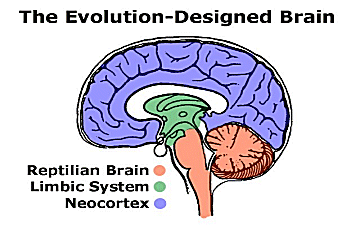
I was taken aback to read, in a frum publication, a reference to the "primitive brain" in connection with our self-defense mechanism, the flight or fight response.   That is jargon used by those who espouse evolution who claim it's the oldest  part of the human brain and a piece of brain anatomy that we share with reptiles.  Not something I expect to see in a frum publication or hear from a frum person!

It reminded me of an article I read on a frum website in which the author referred to "our reptilian brain."  In both cases, frum therapists whose books and articles are very popular in the frum world, show how they have been negatively influenced by their secular education. 

It's disheartening because these authors have a lot of good things to say and it's too bad that we cannot rely on frum authors and frum publications and websites to provide us with untainted Torah-true material.  It also belies the claim that frum men and women can study for a profession and somehow (magically?), because of their yeshiva education and allegiance to Torah, remain unsullied by anti-Torah ideas.  We are encouraged to seek out frum counselors and yet, these same frum counselors may promote ideas that are antithetical to Torah.  Caveat emptor.

Jan 8, 2012

How Many Products Do We Need?


I often read about the thousands of kosher products now available and how the kosher market is huge and is still growing, by leaps and bounds.  That's all fine and good.  It's helpful to Jews who live all over the US (and other countries) to have numerous kosher products available to them at their supermarket. 

What bothers me is where I think the kashrus field has gotten out of hand.  I read about mashgichim who travel to distant countries, leaving wife and children behind for long periods of time.  For example, a mashgiach who makes a trip to China, who has to fly to a remote area where the factory is located.  The factory produces the chemical sustance that stabilizes pareve ice cream, and another substance that stimulates the taste buds in an amazing way so pareve ice cream can taste better than dairy.  If all goes well, the ice cream company will be able to improve the taste, smell and quality of their ice creams.  The cost? The husband away from his family, without a minyan, without any Jewish amenities, without a proper Shabbos if he has to stay away that long.  And for what? For enhanced pareve ice cream.

Have you noticed the aisles full of kosher chips and kosher cookies and crackers? Do we need more kosher snacks? More sauces? More cereals? While we read articles about obesity and eating disorders in our frum publications, we turn the pages and see advertisements for more food products!

I saw a Chanuka ad in a frum magazine which said:

2011 Doughnut Collection
It's Natural to Lose Control


I was singularly unimpressed by this grubbe marketing idea.  But I digress.  Back to kashrus. If the kashrus agencies could explain why it is vital for ordinary products to be supervised by mashgichim living or visiting remote places, I would back down.  But I suspect that too many of the kashrus supervisors' visits could be cut out and those products wouldn't be missed.

Dec 23, 2011

Freezer Lessons


My freezer made a very loud buzzing sound.  So loud that people commented on the noise.  It was audible at the other end of the house and when you were next to it, it was hard to talk on the phone or hear someone in the next room.  But .... I didn't call the repair man because I didn't know what was involved and what it might cost.  The sound didn't worry me (too much) because it seemed to me that something was vibrating.  When the compressor went on, the freezer buzzed.  When it went off, it was quiet.  I didn't think something was broken.  So it kept on buzzing.

Then the other day, someone came to the house and noticed the buzzing and asked why didn't I check it out.  After months of doing nothing, I finally turned the freezer around to take a look, and know what I found? A small cardboard tag on a metal fastener vibrated when the compressor turned on and it made a buzzing sound.  I couldn't believe it! I held the tag and the buzzing subsided.  I let go and it buzzed. 

I got a pair of scissors and cut off the tag and voila! When the compressor turns on, there is a normal sounding hum.  No more buzz.  What a relief.

I think my buzzing freezer is a metaphor for something; I'm not sure what.  I suspect there are two lessons to be derived from this episode, but what are they?

Number one: a huge noise was made by a little card.  The lesson is?

Number two: I allowed it to buzz for months when all it took was turning it around, taking a look, and snipping off the card.  The lesson is?

Dec 21, 2011

How Are We Different?


I saw a news item recently about a woman (apparently not Jewish) who needed a kidney who posted on Craig's List and got 800 responses.  She actually got a kidney from one of them.  That made me think about the items I've read recently about Jews giving kidneys to other Jews, to people they did not know.  It is a special thing to do but after reading about the 800 responses, it made me think about the phrase "Mi k'amcha Yisrael" - Who is like Your Nation Israel, which we use when a Jew does something special and we feel proud.  Kidney donations are not exclusive to Jews!

I was perusing an Italian cookbook in which the author describes her childhood memories of the elaborate preparations that went into making Sunday dinner which was eaten with the family after mass.  Jews are not the only ones who have a weekly, wonderful family meal! Nor are we the only ones to celebrate holidays.  There are non-Jews who take their holidays very seriously and make elaborate preparations and give them a lot of thought.  Shabbos and holiday meals are not exclusive to Jews!  And Americans, in particular, give a lot of charity, run many chesed organizations, do many acts of kindness, and are hospitable to strangers.

This got me thinking - when does the phrase "Mi k'amcha Yisrael" truly apply in a Jews-only sense? What do we do that is unlike any other group for which we can say, "Wow! Mi k'amcha Yisrael!"? Alternatively, maybe there are things that we do that other groups do too, but we do it in far greater numbers or in a special way.

Come on readers out there - share your thoughts!

Dec 16, 2011

How Rational Are We?


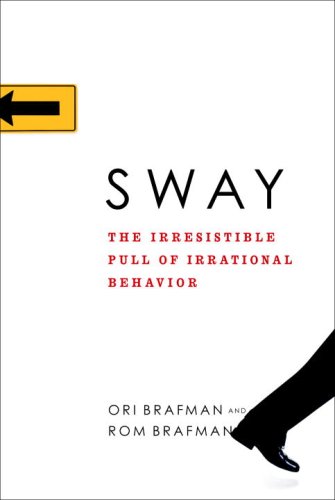
Sway is a quick and interesting read about why people, you and me, do irrational things.  For example, the authors show how we do things against our best interests in order to avoid a loss which leads to far greater losses.  Like a person whose stock value is dropping, who doesn't sell because he harbors the hope that it will go back up.

We draw conclusions about people or things and these conclusions color all subsequent information that we learn.  For example, if we perceive something to be cheap, we treat it as inferior regardless as to its actual worth.

The part that was most worrisome was about how we evaluate people for jobs and longterm relationships.  Seems we ask the wrong questions and even when we observe problems, we gloss over them if we have other reasons for favoring the person or thing that we are interested in.  We need to do a lot of praying when it comes to shidduchim if we cannot rely on ourselves to make logical decisions! The book shows how vulnerable we are, even as we think we are being rational.  It's a sobering look at ourselves.

Dec 14, 2011

Truth in Journalism


As a postscript to the previous post, I was dismayed to learn about the liberties taken with the truth by those who write for women's popular magazines.  Naive me actually believes when I'm told a story is true.  In Sybil Exposed it describes how certain journalists presented fiction as fact. 

The author of Sybil had doubts about the veracity of Sybil's abuse stories.  She actually went to the supposed scene of many crimes and discovered no evidence whatsoever for the abuse claims.  Worst of all, she read a letter Sybil had written to her psychiatrist, denying she had multiple personality disorder.  Her doctor, of course, said she was in denial. 

The author didn't know what to do with all this information.  Furthermore, the story as she knew it wasn't much of a story with a plot and dialogue. 

The ultimate solution? Fictionalizing the story and presenting it as the truth.  Subsequent to the book's becoming a major hit, the author and the pyschiatrist appeared on many shows talking about the book.  By that point, they had certainly convinced themselves that the book was true.

Leaves me wondering, what of what I read and think is true, is actually fiction? Some might say, it doesn't matter.  I've heard this before and been astonished as I've written in this post: click to read previous post

This world is described as Olam Ha'Sheker, a world of lies.  Nothing is as it appears to be.  Fiction can be masquerading as truth.

Sybil Exposed


I did not read Sybil but I am reading Sybil Exposed.  Sybil was a book published in 1973 that went on to become a bestseller and a movie.  It was presented as the true story of a woman treated for multiple personality disorder who had been so horribly abused by her mother that she became a psychiatric case.  The book described grotesque rated R scenes that had the public enthralled.  Not surprisingly, huge numbers of people were diagnosed as having a multiple personality disorder after the book became a hit (like anorexia became a "fad diagnosis" in Hong Kong after it was marketed there, see my post "Crazy Like Us"  click here to read post

The lives of three women are intertwined: the patient, her doctor, and the author of Sybil.  The author of Sybil Exposed shows how the patient's illness wasn't an illness, how her treatment was a sham, and how the fictional story Sybil came to be written and presented as the truth. 

As much as the book is an expose of the book Sybil, it is an expose of the quackery of the psychiatric profession.  As anybody who has read previous posts (labels: psychiatry and mental illness) on this blog have seen, I am not impressed by the pseudo-medical specialty of psychiatry.  The so-called treatments given by the doctor in this case as well as her colleagues back in the 50's till the present day, are a horror.  Forget about "first do no harm."  That is far from their guiding principle.  When will the public finally figure out that the emperor has no clothes? That the psychiatric/mental health profession in cahoots with the drug companies are making us into a nation of drugged, incompetent, invalids?

Dec 4, 2011

A Matter of Perspective


Yaakov is punished for hiding Deena from Eisav in parshas Vayishlach.  When you consider that Shimon and Levi were 13 when they killed the city of Shechem and Dina was younger than them; and when you figure out that Eisav was almost 100 years old, you realize that the Torah's idea of marriage and a husband and wife having a "relationship" is far different than ours. 

The most famous example of this is Rivka being 3 years old and Yitzchok 40 when they married.  Yaakov was 84 when he married Leah and Rochel.  The seemingly romantic scene when Yaakov kissed Rochel at the well occurred when Yaakov was 77. 

Our modern, Western sensibilities look askance at "child brides," and yet, Jewish girls in Yemen and Morocco were often married by 11-12.  The Chofetz Chaim married at 17.  It was commonplace for Eastern European Jews to marry in their mid-teens.

We seem to think we have some sort of monopoly on what is "proper" and what isn't, what is a perversion and what isn't.  Our views are colored by the culture we live in.  We would do well to remember that.

Nov 25, 2011

Inconceivable!


What a medical oops this was! A woman underwent IVF only to be told that the baby she was carrying was not her own, but someone else's embryo! She sustained the pregnancy because she believes in the sanctity of life.  This was a tremendously difficult challenge since the baby wasn't hers and she wasn't going to keep it (although she would have loved to).  The baby went to its genetic parents immediately after it was born.  The book is appropriately named, Inconceivable.

The couple who tells the story, alternating between the husband's voice and the wife's voice, are Catholic.  They wanted a large family and they are devoted to the church, giving it their time, energy and resources.  Interestingly, they defied the Church's position on IVF which is that IVF is morally unacceptable. 

Despite being religious people, they have ideas about G-d that are not what I would call "religious."  She says she does not believe "G-d only gives you what you can handle."  She does not believe G-d tests people.  She does not believe that G-d is in charge of His world, "that He sits up in heaven and decides who gets what tragedy or blessing."  She says, shockingly, "We are certain that G-d didn't do this to us.  We just know it happened."  And she doesn't believe in "gam zu l'tova," that something good will come of this. 

I don't know how widespread these beliefs are among Catholics or Christians in general.  I find it so surprising when these ideas are the bedrock of our emuna.  If she doesn't think G-d is running the world, what does she think G-d is about? That He created the world and retired? I don't want to get into Christian theology but I'd be interested in knowing whether this couple's belief system is shared by many church goers and what they think about reward and punishment. 


Nov 23, 2011

Can't Wait!


An analogy R' Frand gave many years ago made quite an impression on me, since I still remember it! His lecture was about Moshiach and he said that when Americans were held hostage in Lebanon, one of the wives said that every night she was so disappointed that her husband had not been released.  And every morning she anticipated her husband being released that day.  She was that sure it was going to happen.

The wording of the 12th Principle of Faith (Ani Maamin) is, "I believe with complete faith in the coming of Moshiach, and even though he may be delayed, nevertheless I anticipate every day that he will come."

In the 15th bracha of the Shmone Esrei, we say, "... for we hope for Your salvation all day long ..."

How many of us say the bedtime Shema, get into bed, and think - I can't believe it! Moshiach didn't come today! I'm sure he'll come tomorrow!

How many of us get up in the morning and think, "Today is the day! Moshiach is coming!

Let's walk (feel) the talk!

Boruch Hashem


There is lots of talk this week about gratitude, and many articles about feeling thankful and expressing it.  It has been noted that we are called Yehudim from the root meaning thanks, and that we are supposed to say 100 brachos a day.

I am reminded of my elderly great-aunts who have been through a lot in life.  It's good training when a child is asked what he feels grateful about.  However, when the elderly say, "boruch Hashem yom yom" (I bless/thank G-d every day), it is especially touching.  They've experienced sadness and loss and yet, they focus on Hashem's blessings.  May we do the same when we reach their age.

Nov 18, 2011

Positive Psychology - An Oxymoron?


Two days ago there was a news item which said: Medication to treat mental health disorders is soaring among U.S. adults.  20% of all adults said they took at least one medication to treat a mental disorder. Among women, 25% said they took such medication and 20% said they were using an antidepressant.

The number of children under 10 taking antipsychotic medication, which is reserved for the most severe mental illnesses, doubled from 2001 to 2010.

In short, we are either getting crazier and sadder or the psychiatric and pharmaceutical companies are doing a great job convincing us that we are. 

The crying shame is that the voice of psychologists like Dr. Martin Seligman, the father of “positive psychology” who was called “the Freud of the 21st century” by Newsweek, is drowned out by the doom peddlers.  Seligman shocked the world of psychology by focusing on what makes people mentally healthy instead of what makes them mentally ill.

Forbes had an article last week about the upcoming DSM V with an intro that said, "The new manual of mental disorders coins bizarre new psychological disorders, lowers the threshold for diagnosing old ones, and has some critics pulling their hair out."

We are a generation that wants to be victims, that wants to be able to blame our parents, our environment, our genes, our so-called chemical imbalance, anything but ourselves, for our problems.  If you as much as suggest that someone who has truly suffered at the hands of evil people can move past that and have a good life, you are vilified and accused of not understanding the depths of the person's trauma. 

In their sincerity to help molestation victims, they push those hapless individuals down and seek to keep them down.  I suspect it's because they believe that if the person goes on to lead a happy life, it demonstrates that what happened to them was not that egregious.  That's like saying that a Holocaust victim who was stripped of his dignity, who was robbed and beaten, who was a hairsbreadth away from death thousands of times and who lost his parents, spouse, children, extended family and community, could not go on to marry and live a good life.  But thousands did! And they are heroes of the spirit, particularly if they retained their faith and raised religious, upstanding children. 

"Positive Psychology" may seem like an oxymoron but it doesn't have to be.

Nov 10, 2011

An Extra Kidney?


The frum media has had many heartwarming stories lately, about people donating kidneys to those in need, strangers to the donor.  Poskim have ruled that it is permissible to do this.

What I wonder about is the comment, often made by those promoting kidney donations, that perhaps this is the reason why Hashem gave us an "extra" kidney, so we could donate it.  This is predicated on the view that we don't need two kidneys and that we can function perfectly well with one.

This pronouncement does not sit well with me.  Is this really the case, that for millenia, billions of people were given two kidneys by Hashem, so that in our generation, a few people can donate a kidney? It is reminiscent of the medical wisdom of yesteryear in which tonsils and the appendix were considered superfluous and were frequently surgically removed without a compelling reason to do so. 

I'm sure it's true that as of now, with the medical knowledge we have today, it looks as though a person can manage just fine with one kidney, and since a person in dire need of a kidney is in a state of pikuach nefesh, poskim have ruled that a person can donate a kidney.  However, to say that Hashem created us with an extra, unnecessary organ? I'm not convinced.