Yisroel Besser in a Mishpacha article asks the question, what does your family stand for. Answers might include: chesed, Torah study, hospitality, kiruv etc.
I think the question is an interesting one. I hadn't thought of that idea before, that a family might stand for anything. Aren't we all trying to be good Jews, doing mitzvos, learning Torah, celebrating Shabbos and Yom Tov?
But just like a person who is shomer mitzvos might have a particular mitzva that is dear to him, that he excels in (Gemara Shabbos 118b - Avuch bameh havah zahir tfei? What was your father punctilious in observing?), so too, a family can collectively have their specialty. Maybe it's Shabbos, Rosh Chodesh, being friendly to whoever we meet.
If I had to say what it was in the family I grew up in, I would say an inquiring mind, learning, asking questions, thinking for yourself.
Showing posts with label avodas Hashem. Show all posts
Showing posts with label avodas Hashem. Show all posts
May 22, 2017


Feb 15, 2017
Mature Eleven Year Old
An 11 year old commented that she is not looking forward to being bas mitzva because then she will have the ol mitzvos (yoke-responsibility of mitzvos). And she is not looking forward to age 20 because then she will be chayav b'dinei shomayim (obligated by heavenly judgement).
This was presented as something quite negative, that there is no joy in her observance of Yiddishkeit. I countered with - she sounds mature, like a yirei shomayim, not someone fixated on her bas mitzva party and presents.
True, she should be told that Yiddishkeit is about serving Hashem with joy, and this should be emphasized in various ways, with halacha and stories. But how wonderful it is to hear that a child that age takes mitzva observance seriously.
The other extreme is a focus entirely on Hashem loves us no matter what. Although that is true, it seems to be producing people who think they can dress as they please, go where they want, and do what they want, because regardless of their actions, Hashem loves them.
We need to meet in the middle and teach both yiras shomayim which includes yiras cheit, and simcha shel mitzva.
This was presented as something quite negative, that there is no joy in her observance of Yiddishkeit. I countered with - she sounds mature, like a yirei shomayim, not someone fixated on her bas mitzva party and presents.
True, she should be told that Yiddishkeit is about serving Hashem with joy, and this should be emphasized in various ways, with halacha and stories. But how wonderful it is to hear that a child that age takes mitzva observance seriously.
The other extreme is a focus entirely on Hashem loves us no matter what. Although that is true, it seems to be producing people who think they can dress as they please, go where they want, and do what they want, because regardless of their actions, Hashem loves them.
We need to meet in the middle and teach both yiras shomayim which includes yiras cheit, and simcha shel mitzva.
Nov 25, 2015
No Such Thing as Being in Limbo

There was a sad write-up about the fifth person to die in the Har Nof shul massacre, Chaim Rothman, who lingered for almost a year after the attack last November. Mishpacha interviewed his wife who said a most remarkable thing.
Someone commented to her, "Risa, poor thing, you're in limbo." And she could have remained in this situation for years, with her husband comatose, terribly injured, and she raising her large family, the youngest is five, on her own.
But Mrs. Rothman said, "That comment didn't sit well with me, and the next day I realized why. I realized, no, I'm not in limbo. There's no such thing. This 'limbo' place is exactly the place where I'm supposed to do my avodas Hashem, not waiting for the time when it will be better. Someone who's waiting for a shidduch or a baby or any other yeshua, this is where you have to do your avoda - in the waiting, not when it gets better. Limbo is now, limbo is here, where I have to develop myself, not this happy picture of where I would like to see myself."
May 30, 2015
Investing Our Energy
We often read or hear about fulfilling our tafkid, our life's mission. Aside from learning Torah and doing mitzvos, which is incumbent on us all, we might wonder: what is my particular life's mission?
Ideas for direction include 1) that which you are drawn to and 2) that which you find difficult. True, if you are drawn to something, it could be because that is where your tafkid lies. At the same time, if some area of mitzvos is difficult for you, that could very well be where your tafkid lies, although there is something contradictory about that, isn't there ...
I came across this line which I liked, which relates to figuring out where to put one's energies. It goes like this: "It is not something that I believe I should do; it's something that I cannot help but do."
Ideas for direction include 1) that which you are drawn to and 2) that which you find difficult. True, if you are drawn to something, it could be because that is where your tafkid lies. At the same time, if some area of mitzvos is difficult for you, that could very well be where your tafkid lies, although there is something contradictory about that, isn't there ...
I came across this line which I liked, which relates to figuring out where to put one's energies. It goes like this: "It is not something that I believe I should do; it's something that I cannot help but do."
Nov 23, 2014
What Does it Mean to Serve Hashem?
R' Manis Friedman, a popular Lubavitcher public speaker, likes to tell of his
night-long dialogue with a non-Chassidic kollel guy about whether Hashem needs us,
whether we need to have rachmanus on Him for making Himself
vulnerable to our freedom of choice. The kollel guy says Hashem is
perfect, how He can need anything?!
In it (in the edition with R' Avigdor Miller's commentary, p. 66, 72), it says the definition of avoda is the feeling of humility of someone who receives a benefit.
What can we do for Hashem? Nothing, because Hashem does not need anything. But one thing we can do for Him is make something out of ourselves. How do we do this? By working to show our gratitude for what He does for us. Avoda is the service of Hashem that comes from a feeling of gratitude.
We contemplate His greatness, His wisdom, and everything He has done for us. It includes thinking of all the things He does in the world that reveal His presence. All the mitzvos of the Torah are only an introduction to this career of avoda.
MF says, needing a mitzva is not an imperfection. But let's say it is.
What would you prefer that Hashem is perfect or that Hashem needs
you?
Kollel
guy said, that He's perfect.
MF
asks, why do you need Him to be perfect?
Kollel
guy says, because if He's not perfect, I won't serve him.
MF says,
if you're right that Hashem doesn't need anything, what does it mean
ivdu es Hashem – what kind of service can you do?
Kollel
guy said that's the one thing I never understood ... By
telling me that Hashem needs my mitzva, you're turning me off. If He
needs it, let Him do it!
Mf: If
you did not need anything, you wouldn't be a human being. To say
that Hashem needs, makes people uncomfortable because our needs are
seen as weaknesses.
Yes,
there are needs that are weaknesses like eating and sleeping, but a
need like friendship makes us human. If Hashem needs something, that
makes Him a living G-d.
*****
Just because the Kollel guy never came up with an answer for what it means to serve Hashem, doesn't mean there isn't an answer that doesn't require G-d needing something. In Chovos Ha'Levavos, written by a Rishon, there is an entire section on the Service of G-d - Shaar Avodas Ha'Elokim. In it (in the edition with R' Avigdor Miller's commentary, p. 66, 72), it says the definition of avoda is the feeling of humility of someone who receives a benefit.
What can we do for Hashem? Nothing, because Hashem does not need anything. But one thing we can do for Him is make something out of ourselves. How do we do this? By working to show our gratitude for what He does for us. Avoda is the service of Hashem that comes from a feeling of gratitude.
We contemplate His greatness, His wisdom, and everything He has done for us. It includes thinking of all the things He does in the world that reveal His presence. All the mitzvos of the Torah are only an introduction to this career of avoda.
Mar 30, 2014
Love-Timing-Details

Leiby Burnham was a guest lecturer for a retreat in Yosemite. There were three photographers on the trip who were eagerly after the best shots at all hours of the day and night.
He learned three major life lessons from them:
1) When you truly love something, nothing is too difficult.
There was no task too hard for them because they LOVE photography and were willing to work 200% harder for a shot that would be only 2% better.
Lesson: Instilling love for Hashem and mitzvos is the goal. Many of our frum society's "issues" would melt away if we were successful at this.
Lesson: Instilling love for Hashem and mitzvos is the goal. Many of our frum society's "issues" would melt away if we were successful at this.
2) They sat down each night to strategize the next day's photo shoots. They had only a limited amount of time and they wanted to make sure they got all the shots they needed.
Lesson: We only have a limited time here on Earth and need to maximize the time.
3) Many of us take pictures but these professionals were obsessed with the details.
Lesson: As Burnham put it, people often wonder, does Hashem really care about my kavana, about how I remove pits from cantaloupe on Shabbos? Isn't Yiddishkeit mainly about connecting to Hashem? Are we losing the feeling and passion in the details?
Lesson: As Burnham put it, people often wonder, does Hashem really care about my kavana, about how I remove pits from cantaloupe on Shabbos? Isn't Yiddishkeit mainly about connecting to Hashem? Are we losing the feeling and passion in the details?
The truth is, Hashem does care about the details, because He wants each of us to create a masterpiece. (And here's a point that Burnham makes so well:) Leonardo da Vinci didn't paint the Mona Lisa by just focusing on the "spirit" of the painting. Motzart did not create masterful music by just thinking about the feeling behind the music; he meticulously worked on every single note. L'havdil, Hashem gave us clear instructions for so many of the details because passion and love are great but mastery is in the details.
Mar 16, 2014
Little Things Add Up

I enlarged the photo in this recent post about health here so the words "Why small choices make a big difference" would be clear. Life is made up of small choices. Every moment, whether we think about it or not, is a choice. I am doing this; I could be doing that.
There was an article by Leiby Burnham, who regularly writes for Binah magazine, which drove home the point of the importance of small decisions. He described panicking when his street flooded. He called a neighbor, the type who always knows what to do, and the neighbor came out with a long pole with a metal claw on the end. He poked around with it while explaining that the sewer covers have holes that get stuffed with leaves. When he pulled out the leaves, the water quickly drained away.
Burnham noted that the clog that flooded his street was made up of small twigs and a few clumps of grass which were easily removed. The removal of the blockage took two minutes. Contemplating this he realized this is a good metaphor for life. "It is usually not the big things that make the most dramatic changes in our life, but the little things. The big things can be disruptive, but it is the little things that make the man."
He goes on to say that marriages are not made and broken by the big things, the big gifts or the angry scene. They are made up of the daily little interactions, the greetings, the expressions of gratitude, the helping out. And they are broken by the little things, the repeated actions and words that bother the other spouse.
He quotes a famous marriage counselor as telling him, "Divorces are almost never about the big things; they are always about the little things." He goes on to clarify, that these little things accumulate and "clog" the relationship and eventually "flood" the marriage with resentment.
He says that at work the same principle applies. "It is not the person who can pull impressive spreadsheets, give great presentations or the amount of overtime hours put in. Rather, it is the person with the can-do attitude who responds with a simple 'yes' to as many requests as possible."
Of course he mentions health as well, the point emphasized in the book I reviewed in the post mentioned above. "Good health doesn't come from big surgeries and expensive procedures" but from eating right, moving a lot, and sleeping enough and well, all on a regular basis.
I like the way he concludes on a spiritual note with the Rambam that says it is much better to give small amounts to tzedaka many times than the same amount one time, because by doing a mitzvah over and over again, we change ourselves for the better and become giving people. Writing one check does not have that impact.
It is our frequent tefillos, our thinking of Hashem constantly, always looking for the hashgacha pratis and thanking Hashem, our constant mitzvos that add up.
"It may seem small, but those little twigs and leaves will soon gather together and change our entire lives, flooding us with a greater sensitivity in our observance in both mitzvos between us and Hashem and between us and our fellow Jews. Sweat the small stuff."
As the Rambam also says, we need to see ourselves and the world in equal balance and just one deed can tip the scales.
Jan 31, 2014
Putting in the Work

Miriam Stark Zakon wrote an article about having completed a year long study of bitachon which is all about putting Hashem in the picture, and then encountering a frustrating situation in which Hashem wasn't in the picture for her at all.
"I realized that in my search for bitachon, I'd been enjoying the company of a fantastic group of women, basking in the intellectual and emotional stimulation of a shiur, maybe taking a few baby steps in the direction of self-improvement."
Her epiphany was, "Baby steps don't win marathons. You want to win bitachon? You've got to work. You've got to do more than you ever thought you could do."
She had felt so good about spending a year studying an important subject. It took a temper tantrum for something not going her way to make her realize the dissonance between what she had spent the year studying along with the pride she took in it, and how much it had actually changed her.
I found this a valuable insight. For those who like to learn, it can be gratifying just getting through the material and feeling that sense of satisfaction. For those who do this in groups, it can be stimulating and delightful to learn along with others. It all makes an impact, but like the author points out, if you want more than that, you need to put in work to master anything.
Dec 8, 2013
Spiritual DNA

I read a terrific chinuch idea in an article by Rabbi Hillel Belsky, printed in Hamodia's Inyan magazine.
He described a talmid of his whose achievements in general were average but who was particularly devoted to tefilla b'tzibbur. He never missed a minyan and the disparity between his punctiliousness with this mitzvah and other areas of his spiritual life was obvious. "Upon investigation, I learned that his grandfather, whom he had not known, used to stand on street corners trying to collect people for a minyan in a dying neighborhood."
R' Belsky is the founder and dean of a seminary in Yerushalayim and he says he tries to enlist his students to search their family backgrounds to find the specialness of their ancestors. "Who were they? Were they known for anything special, big or small? Any area of avodas Hashem for which they were moser nefesh? It all becomes a part of their singular and collective spiritual DNA."
The idea is "to encourage students to claim their forebears' strengths as their own." On the subject of Shabbos, the students were asked to find out about any instances of mesirus nefesh for Shabbos on the part of their parents, grandparents and so on. He says "the stories the girls told could have filled a book!"
"Every family has stories. I want my students to connect to these stories."
And it's true. A family does not have to be illustrious to have inspirational stories. A family does not even have to be religious to have mitzva-related inspiring stories. We need to speak to family members and glean these stories so that we have personal inspiration to draw upon.
Jul 30, 2013
Bon Appetit

A quote from a food editor in a frum magazine:
"These days, whether we're reading about it in a magazine, or watching it live on stage at a fundraiser, cooking has become great entertainment. It's a positive thing. In every Jewish community, our interest in cooking is being leveraged to plan events and raise tzedaka for both chesed and Torah institutions."
I'm thinking there just might be a bias there, considering who said that ... Are there any Torah sources that say that immersion in the world of food is a positive thing? The sources I've come across have a different perspective:
* The Gemara interprets "kedoshim tihiyu" (Vayikra19:2), "Be holy" as a mitzva to "abstain also from that which is permissible to you" and a warning against being a naval b'reshus ha'Torah (a hedonist with the Torah's permission) who indulges in every permissible pleasure.
* A quote from Chovos Ha'Levavos (Duties of the Heart) in the introduction to Shaar Avodas Hashem says: "Desires for worldly pleasures are unable to dwell in the heart together with a love of G-d."
* Tosfos in Kesubos (104a) quotes the Medrash. It says before a person prays that Torah goes into his system, he should pray that delicacies don't go into his system. Rabbi Yehudah HaNassi had the finest foods in the winter and in the summer. The Gemara says that when Rav Yehuda HaNassi died, he lifted up his ten fingers and said Ribono Shel Olam, it is known and revealed to you, that I toiled with my ten fingers and I didn't even have the pleasure of my smallest finger. Rabbi Yehuda HaNasi was at such a high spiritual level that despite his extravagant lifestyle he could testify that during his entire lifetime nothing was consumed for his own enjoyment.
We may not have to eschew trying a new recipe, but to glorify gastronomic delights and to say that immersing oneself in the culinary world is a good thing is something else entirely.
Apr 19, 2013
The Theory of Absolute

Rabbi Zecharia Wallerstein gave a thought provoking post-Pesach talk. He said this was the talk he gave at a hotel in Florida as the closing speech for the Pesach program there. (He reassured his audience that he was home for the first days of Yom Tov, since he speaks about the importance of spending Yom Tov at home).
He pointed out that people managed without a phone and Internet for five days, for the first and last days of Yom Tov plus Shabbos Chol Ha'Moed. His friends, who smoke two and a half packs of cigarettes a day, manage without a cigarette on Shabbos and don't have withdrawal symptoms. How is this possible?
Regarding the phone and Internet, people say it's because nobody else is using it either and there is nobody to communicate with, so it's easy to refrain on Shabbos and Yom Tov. However, that doesn't apply to those who smoke or those who tell him that they can't fall asleep without watching a movie. The reason why Jews can refrain on Shabbos and Yom Tov, he says, and they don't even have physical withdrawal symptoms, is because they regard these prohibited activities as absolutely off-limits. Just like his grandson stopped whining for chocolate when Zaidy said it wasn't kosher. Frum children will not persist in asking for a food item if they are told it's not kosher. Why? Because it's absolutely not acceptable and they know it.
R' Wallerstein went on to describe his gambling history and how caught up he was in it. He
said that praying to Hashem and swearing he'd stop gambling, if G-d replaced his money so he
could pay off his debts, did not help. He went back to gambling.
What stopped him was "happening" to come across the sefer Kav Ha'Yashar and seeing what he says about
ill-gained money, how the good things done with it go to the “other
side.” He pointed out that people managed without a phone and Internet for five days, for the first and last days of Yom Tov plus Shabbos Chol Ha'Moed. His friends, who smoke two and a half packs of cigarettes a day, manage without a cigarette on Shabbos and don't have withdrawal symptoms. How is this possible?
Regarding the phone and Internet, people say it's because nobody else is using it either and there is nobody to communicate with, so it's easy to refrain on Shabbos and Yom Tov. However, that doesn't apply to those who smoke or those who tell him that they can't fall asleep without watching a movie. The reason why Jews can refrain on Shabbos and Yom Tov, he says, and they don't even have physical withdrawal symptoms, is because they regard these prohibited activities as absolutely off-limits. Just like his grandson stopped whining for chocolate when Zaidy said it wasn't kosher. Frum children will not persist in asking for a food item if they are told it's not kosher. Why? Because it's absolutely not acceptable and they know it.
Gambling was no longer a taava for him. It became absolutely off-limits. He didn't need a 12 Step program or any kind of therapy. Once that "clicked" in his mind, gambling became a non-issue for him.
What are our absolutes, our red lines? It seems with R' Wallerstein to have been an "Act of G-d." Hashem directed him to the particular sefer and the particular page that made a deep impression on him. That wouldn't necessarily work for someone else. How can we gain the Absolute mindset?
You can watch his talk here
Feb 3, 2013
Not Quite Kosher Indulgence

An ad in a frum magazine:
GOT CRAVINGS?
chocolate + caramel
and it showed a bag of chocolates.
I translate this ad into:
GOT TAAVOS? Indulge in chocolate
***
In the same magazine an ad for a liquor store says:
Expanding your palate with select international wines
I translate this ad into:
Don't have enough taavos? Let us help you expand your repertoire.
***
I suspect that one of the reasons we say on Yom Kippur:
al cheit she'chatanu lifanecha b'maachal u'v'mishteh - for the sin that we sinned before You with eating and drinking, is because we indulged our cravings and expanded our palates and G-d wasn't in the picture.
Aug 27, 2012
Bi-Polar Judaism
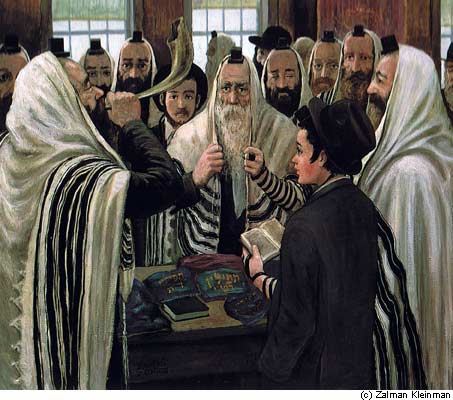
Elul is an incredible gift.
Elul is a time when even the fish in the sea tremble.
Elul is a time of Divine grace, when the 13 Middos of Mercy prevail.
Elul is when we prepare for our upcoming court case in which our lives hang in the balance.
Elul is a time of Divine love, joy, and closeness, when "I am to my Beloved and my Beloved is to me."
Elul's shofar is like the bell that signals the end of recess. Time to buckle down and do teshuva.
Hashem is our loving father.
Hashem is the judge who examines every thought, word and deed we did.
****
If a capital case is going to be tried, the defendant doesn't feel like it's a gift and a joyous time. Love and closeness don't go together with intense scrutiny.
Will the real Elul please stand up?
Jul 17, 2012
GPS - Navigation for Your Soul

I'm really enjoying this book, "GPS - Navigation for Your Soul - inspired by the writings of the Nesivos Shalom" (an Artscroll Shaar Press publication).
There are chapters on Hashem's tremendous love for every Jew and how nothing we can do can eradicate that love, how to respond to our challenges in life, and the power of our mind. Rather than present fundamental ideas in ordinary essay form, the authors use an extremely friendly layout and format that engages the reader. Although I am familiar with the ideas that are presented, I am interested in reading all 487 pages because it is a pleasure to read this book.
It is an excellent source of inspiration and a reminder about who we are, what our relationship with Hashem is about, and what we are here to accomplish, suitable for teens and up.
Jun 29, 2012
Loving Shabbos

This same R' Bensoussan (see previous post) said that on his way to or from shul on Shabbos, his father would say to him and his brothers, time and again, each time as though he never said it before, “This is very important. No matter where you end up and what you do, there is nothing as amazing, as beautiful as Shabbat.”
During the meal his father would almost break into tears and say there is nothing like Shabbat. R' Bensoussan's friends would break Shabbat in front of him but he never could. As he put it, why would he want to break Shabbat? There is no beauty that compares! He doesn't use the phone, text etc. on Shabbat because why would he?! He has Shabbat.
So this seems to be the new approach to convey the imperative of living a religiously observant life. It's not because G-d said so. It's not because of reward and punishment. It's because it's beautiful and enjoyable.
Sounds nice, but ... where does G-d fit into the picture? It sounds like it's all about me and what makes me feel good. Nothing about a relationship with G-d. Dovid Ha'Melech's pining for G-d seems irrelevant. Purpose, responsibility, obligation seem to play no role. It's all about my pleasure. Something is wrong with this picture, though apparently many feel this is what speaks to today's youth. Do they ever move on to the next level or is that not a goal?
Jun 28, 2012
Loving This World

In a lecture given by R' Yossi Bensoussan, he quotes a speech that a rosh yeshiva of a yeshiva in Israel says to the boys:
"Do you know why I'm religious? I'm an olam ha'zeh'nik. I love this world; I love the pleasures of this world. Because I'm so into physical pleasure, I am a religious Jew. Because if you do this, i.e. Torah and mitzvos, and do it right, you will never feel so high or elated in your entire life. Anyone who tells you they are religious because of the next world is fooling themselves and fooling you.
“I am religious because of the pleasure I get out of it in this world. Of all the materialistic pleasures of this world (and I wasn't always religious), religious life is most pleasurable. As it says “ashrecha v'tov lach” - ashrecha in this world and tov lach in Olam Haba. We don't know anything about the next world, but we know this world."
Interesting, isn't it? I'm old school. Olam Haba does mean a lot to me. I have heard numerous lectures by Rabbi Avigdor Miller z'l who spoke so much about preparing for the next world, though he too urged people to be happy in this world by seeing what a wonderful world G-d created. So I don't accept that rabbi's statement that Olam Haba is not a real reason that motivates us to be religious. It is not the only reason, but it's a reason!
to be continued
Jun 26, 2012
Just Because

This week, we read about the Para Aduma. The laws of the Red Heifer are so mysterious that even the wisest of men, King Shlomo, said he did not understand it.
There is a halacha in the mishna about not reading by candlelight on Shabbos. The mishna does not give a reason for this (as opposed to the rabbis of the beraisa who gave a reason, i.e. lest a person adjust the light which is prohibited on Shabbos). The Vilna Gaon learns from this that we should not tell people not to do something because of any reason. Once you give a reason, you open yourself up to people thinking the reason does not apply to them or to their circumstance. Reasons provide people with excuses.
And this is what the Para Aduma teaches us. "Zos chukas ha'Torah" - this is the law of the Torah. It is not just a law concerning impurity and purity. It is a law that applies to all of Torah. We observe the mitzvos whether we understand them or not.
I read this dvar Torah and thought about those who espouse teaching everything with explanations and reasons as they do in baal teshuva schools. There is certainly an honored place for reasons. They are called "taamei ha'mitzvos" and books like the Sefer Ha'Chinuch, which provides explanations for the mitzvos, are classics in our Torah literature. However, a foundational message needs to be conveyed loud and clear - we keep Torah and mitzvos because Hashem said so, whether we like the reasons offered or not.
We do a disservice by seeking to ingratiate ourselves by constantly providing "relevance" and reasons for what we do. When we present a reason, it should be understood that we do the mitzva regardless, and the reason is merely to give us an appreciation for mitzvos and insights as to their benefit and purpose. Mitzvos are not negotiable and at the same time that we offer rationales for them, we should be conveying the beauty of the anashim peshutim (simple people) who serve Hashem with love and joy in simple faith.
May 25, 2012
Spiritual Growth - Where? I Don't See It

You can skip this post if you don't want to be pulled down into my negativity. I've been thinking, on and off, over this Sefiras Ha'Omer period, about how these are meant to be 49 days of spiritual growth. I've listened to a number of shiurim that discussed the sefiros and were about working on chesed, gevura etc. I own and have read two books that go into the 49 permutations of the sefiros and give examples of how to implement them.
And with all that, the only thing I manage to accomplish is to count the omer (no small accomplishment, as every mitzva is great). The weeks go by and the specific combination of sefiros just pass me by. The examples in the books do not spark my interest. It seems to me that with all the talk about 49 levels of spiritual growth, nothing actually happens.
This is actually an old complaint of mine. Did you feel cheirus on Pesach (to cite a recent example)? It seems to me that even for those who are serious about learning and changing, there is a lot of reading and a lot of attending or listening to shiurim, but no real results. By "real" I mean something measurable, being able to look back and say - I was there before Pesach and I am here now. I suppose I should just speak for myself. For all I know, many people can look back with satisfaction at how they refined 49 middos, but I have a tiny suspicion that I am not alone.
Apr 27, 2012
All About Me

Aish is running a series on the Six Constant Mitzvos again. This is the second year that one can subscribe to it during sefira. It's a great idea to bring these mitzvos to people's attention and I read the emails and watch the videos.
However, I am finding the angle they are using this year jarring. In the desire to make this topic interesting and relevant and different than last year, these mitzvos are presented from the perspective of "how can I use them every single day to be more successful in everything that I do in my life." In other words, they are taking the mitzvos that focus our attention on G-d, and twisting them into a focus on self!
Jan 25, 2012
Finding Your Passion 2

Hamodia magazine had an interesting article (July 27, 2011) about the exciting work of Rabbi Dan Roth, director of Torah Live: click here to see website. He provides multi-media presentations on topics in halacha and hashkafa in an engaging way. He saw that students today who spend their free time texting and using other gadgets were not interested in a traditional shiur, so he decided to use the same media the kids use, to teach them.
As I've written previously: click here, I find it fascinating to read about people who have found their passion, whether they do so as a child or teen or unexpectedly later in life. R' Roth had been learning Gemara full-time in kollel and there was a Torah topic (Pirkei Avos) that he wanted to write about. He didn't think it was right to leave his Gemara learning to do this.
He asked Rabbi Dovid Orlofsky for his advice which was: "בּן עשׂרים לרדוף Age 20 is for pursuing; בּן שׁלשׁים לכּח age 30 is for strength (as it says in Pirkei Avos 5:25). Martial arts experts are able to break slabs of wood and concrete with their bare hands because they know how to focus all their energy into one point. Your twenties are meant for exploring various life goals and options, to learn what you like and what you're good at. By the time you reach thirty, however, you are expected to know enough about your strengths and character to be able to strip away everything else and focus all your energies and abilities into your unique talent. That's what strength means."
R' Roth had just turned thirty. Inspired by what R' Orlofsky told him, he spent the next three years writing a sefer on Pirkei Avos. Then he got a job teaching OTD youth. The class was a disaster with the students ignoring him. This prompted him to present material in today's language, via computer, and it was a big hit.
He says, "This is my life's calling. It drives me day and night. I feel a responsibility to help as many Yidden as possible get clarity about Hashem's Torah. My biggest dream is to increase k'vod shomayim in the world.
"Hashem gave each of us natural talents and abilities that we have to use in avodas Hashem. A few years ago, when I was in kollel, financial and family pressure for me to get a job was mounting, but I couldn't figure out what I was going to do with my life. I literally couldn't sleep at night, wondering what my next step would be. I never had any idea that I would end up doing anything like what I'm doing today. Hashem guided my every step."
Subscribe to:
Posts (Atom)

 Posts
Posts

