Showing posts with label Ahavas Yisrael. Show all posts

Sep 19, 2016

Everything is Up for Discussion

There was an interesting article by R' Dovid Hofstedter in Mishpacha magazine in which he questions whether the overabundance of negative information we are bombarded with is good for us. 

He brings Torah examples that demonstrate that exposure to negative things has an effect on us, even when those things are mitzvah related (like destroying an ir nidachas or seeing a sota in her disgrace). 

Furthermore, R' Hofstedter says, we become connected to what we see and if we are connected to it, we are disconnected from Hashem.  "Every connection to something extraneous from Torah and mitzvos, even something that is not prohibited, detaches us and disconnects us from Torah and mitzvos, our ultimate connection to Hashem."

It is interesting that Mishpacha printed his article which says "All kinds of topics that in the not-too-distant past were never found in our publications, now not only appear in print but also become conversation points at the Shabbos table and therefore, part of our lives.  They thus attain a measure of de facto acceptability." 

Not only that, but people say how "brave" the publication is for writing about what was formerly taboo! They think that somehow, magically, just by discussing it, we have accomplished something, even if all it amounts to is someone feeling better for having read it.  But what about the negative fallout for bringing it out into the open?
 
Related posts are here and here.
 

Oct 28, 2015

A Tzadekes in Our Time

This article here was published in 2002 about Mrs. Henny Machlis a'h and this one here in 2009.  I read them back then, and was amazed.

To my dismay, I read of her tragic passing at the young age of 58 on October 16 - 3 Cheshvan, after a horrible illness here.

I'm seeing new articles about her, here and there.  They tell about her remarkable outlook on life, how she truly believed and did not merely say that Hashem is in charge, how she loved children so that nine out of her fourteen children were born via C-section, how she excelled bein adam la'Makom and bein adam la'chaveiro.  And she was born in Brooklyn, to kind parents to be sure, but it wasn't like she came from an exotic locale, born to a kabbalist, and raised in unusual circumstances.  That's what make her accomplishments that much more incredible as well as doable. 

Mar 26, 2015

On Being a Good Guest


The following is a direct quote from a very hospitable person who shared this fascinating observation about a special person:

When M. is around, if your kids misbehave ... she just pretends she doesn't see.
She acts as if she's very busy doing something and she doesn't notice.
She makes no comments and doesn't notice anything that doesn't involve her.
She doesn't even say, "Wow you handled that in an amazing way," because she didn't see anything, so she has nothing to comment on!
 
It's hard to have people around noticing things and making comments; trust me, I have lots of company and everyone has comments to make on something.
 
Except M.  She is of the "see no evil, hear no evil" type, and it's so comfortable to have her around.

Nov 22, 2014

In His Final Moments

We now mark six years since the murders of four Jewish men and two Jewish women, including the shliach and shlucha, in the Chabad house in Bombay.

The shliach's Gavriel Noach's father said that ZAKA told him that they can now tell him what they saw in the video from the Chabad house.

After Gavriel Noach was shot and was bleeding profusely, he crawled to where the talleisim were and placed them over the bodies of the others who had been killed. That was an act of chesed that he did, for kavod ha'meis, in his final moments.

R' Holtzberg also related how in India they cremate bodies and give a very hard time about releasing bodies, even to be buried out of the country. An Israeli had died in prison and Gavriel wanted to send the body back to Israel, but the Indian government refused.  Gavriel stood at the bed and said he is not moving until the body is released.

Yehi zichro baruch along with the other kedoshim.

Sep 20, 2014

Who are You Really?


R' Aharon Weinberg, a Slonimer Chassid and speaker, told a story about R' Godel Eisner, Gerrer mashgiach in Chidushei Ha'Rim.  He kept the bachurim going during the worst of the war years, and was always demanding things of them while giving them hope for the future.

Then he was mechazek people after the war.  There was one bachur who dropped Yiddishkeit but R' Godel did not say a word to him about his behavior.  This bachur had a 'pass' and this was regarded with much astonishment.

Half a year after the war, he told R' Godel that he's getting married. To who? A goyta. R' Godel thought for a moment and said a goyta? I don't think it posses (suits) a chassidishe bachur.

Who me, a Chassidishe bachur, the fellow asked?

Said R' Godel, of course you're a chassidishe bachur! The war affected all of us, and some are quicker and some slower [to come back to Yiddishkeit].  I, for example, am quick, and right after the war I went to mincha.  Remember Yankel? He came back the first Shabbos.  Others took a few months.

The bachur burst out crying and asked for a Chassidishe hat.

What a brilliant mashgiach!

Aug 17, 2014

Lecture Roundup II


Charlie Harary on achdus -

He says we think unity is smiling at others and doing acts of kindness which are great, but not achdus. Achdus is when the name on the front, “G-d”, is more important than the name on the back.  This is a sports reference to the jerseys that hockey (and other sports) players wear with their personal name on the back and the team they're playing for, on the front. 

He told the story of Herb Brooks, the US Olympic hockey coach  of 1980 whose team won the gold.  Brooks worked hard to take a bunch of guys from different places and meld them into a team whose focus was on winning for the USA. 

Every day we put on a jersey called G-d, says Harary, and the only question we ask all day is whether the name on the front is more important than the name on the back. Is it all about me or all about Hashem?

When G-d becomes more important, then I don't have to like you or accept you, because I recognize that we need every single Jew to represent Hashem in this world!  Acceptance of others is not what it's about. There is a reason why we're here and we are being used by G-d to represent Him to the world.
 
No matter who we are, no matter the name on the back, we all have the same thing on the front.  G-d.

Aug 16, 2014

Lecture Roundup

Since, as of this writing, we still don't have the third Beis Ha'Mikdash, it's still timely to post a summary of some of the points various lecturers made recently about sinas chinam and unity.

R' Akiva Rutenberg - He said sinas chinam is apathy; I don't think so.

R' David Fohrman did an excellent 5 part video presentation here in which he maintains, based on the Kamtza-Bar Kamtza story, that sinas chinam is disproportionate anger.  Not convinced that's what sinas chinam is.

R' Benzion Klatzko - He spoke bluntly about our lack of unity.  Unlike many other speakers who extolled the unity of the Jewish people over the past two months, he says he doesn't see that the Sefardic-Ashkenazic, religious-secular, Chassidic-non-Chassidic divide has been bridged.  He highlighted and praised the dozens of chesed organizations that we have but said he didn't see unity at the Siyum Ha'Shas, i.e. he did not see it bringing together all kinds of Jews. 

I agree with him.  So much chesed is done and it crosses lines, i.e. we don't only do chesed for our "own kind," but there still is very much that feeling of "us" and them."  Who is us? Whatever group you affiliate with.  And who is them? The other people out there.  I wrote about it here

to be continued

Jun 19, 2014

Maintaining Dignity

In today's day and age, maintaining dignity is not high on people's list of priorities.  People (out in the world) dress in undignified ways, talk in undignified ways, and share personal information that undermines their dignity. 

R' Avigdor Miller was known for his shoot from the hip style.  He famously said, don't tell your spouse about the C you got in chemistry! People tell derogatory information about themselves for no purpose, seemingly for the sake of "being honest" and "accept me as I am."  R' Miller saw no purpose in this; on the contrary, he considered it detrimental.

He also told his Beis Yaakov students, not to wash the floor when their husbands were around.  No doubt, this was to preserve their dignity, especially back in the day when floors were washed on hands and knees.

It is an act of Ahavas Yisrael when we protect a person's dignity, by not looking at things that shouldn't be stared at, by ignoring those things that people say or do that are silly, by enabling them to maintain a façade and not "blowing their cover." 

Jun 17, 2014

Mitzva Intentions


The story is told about a Kotzker Chassid walking on the road, trudging along in the snow on his way to Kotzk, when a fancy carriage stopped nearby.  The man in the carriage offered the Chassid a ride.

The Chassid said, okay, if you pay me 200 zloty.

Huh? said the man on the wagon.  I am offering you a ride.

Uh huh.  So I want 200 zloty.

But why? I am doing you a favor!

Said the Chassid: You don't really care about me.  Just as you pay for an esrog and just as you pay for matza, so too, you should pay for this mitzva of giving me a ride!

Ahavas Yisrael means to genuinely care for another person.  That's the mitzva: V'ohavta l'rei'acha kamocha. 

Jun 16, 2014

Are they "Our Boys" or "Their Boys"?

Jews all over the world care about the three kidnapped boys.  I am sure of that.

That being said, I wonder how many people saw the headlines on Friday about "yeshiva boys kidnapped," and had a certain image in their minds which was dispelled when they saw what the boys look like. 

Oh.  Yeshiva boys don't necessarily wear black hats. 

I wondered: what if the boys' pictures showed them wearing black hats and white shirts? You know, "our kind" of yeshiva boys ... whether "yeshivish" or "chassidish." Would our personal reaction be any different? Would our community's reaction be any different?

I saw the photos of the mass tefilla at the Kosel.  I saw lots and lots of hatless people.  Knitted kippa wearing people.  Almost no black hats.  Where were the all "black hats" when this asifa took place? Why weren't they at the Kosel too? Because "their" black-hatted leaders did not tell them to go? Why not?

Even as we unite in praying for the safe return of the boys, I see disunity amongst us.  Unity and disunity.

Jan 20, 2014

Mind Your Own Business?

* Someone says, "They say that we should let young couples make their own mistakes.  I think that's ridiculous! What sense is there in that? I was happy to be told how to avoid mistakes."

* Someone says, "I used to think it was a good idea, a chesed, to offer good advice.  My father says, don't offer advice to people unless they ask for it.  Why? Because unless they ask for it (and even if they do), they are not receptive to listening to it."

* Someone asks, "I have a tendency to tell people what to do because I really care and because often I am knowledgeable about a subject that the other person is not.  I always thought of myself as helpful, but a relative told me that my constant advice giving is annoying."

We live in a country in which independence is championed and "mind your own business" (MYOB) is a value.

And yet, what are we to learn from Yisro? He observed the situation of Moshe and the Jewish people in the desert and he critiqued it.  Without being asked.  (And he was an in-law, no less, who is warned to MYOB!) And then he gave advice.  And Moshe accepted it.

Should we emulate Yisro when we see something amiss? Or maybe the lesson to learn from this is to emulate Moshe who, when told that the way he was handling the situation was detrimental and was given advice, accepted it!

Sep 12, 2013

Be a Guest - Be a Host!


I received an email which informed me that someone on Shabbat.com had sent me a message, asking whether he could join us for a meal on Yom Tov. 

Have you seen the site? You can sign up as a guest or a host and then, either wait for someone to invite you or to ask you for an invitation, or actively seek a guest or a host.  This person lives in a different neighborhood and will be davening in my area on Yom Tov.

I checked out his profile and then spoke to one of his references (in Arizona), just to ascertain that he is a normal person.  I was reassured that yes he is, and a mentch.  That was enough for me to send a message back to him.  We exchanged a few messages, about food preferences and timing and we are on!

Isn't this special? A "brother," a fellow Jew we never met before, will join us in our succa! How exciting!

Feb 14, 2013

Sticking Up for our Fellow Jew

The scene: You are in a store and see someone shoplifting.  What do you do? Tell the manager/owner? Confront the person? Look away?

The discussion:

A says: It's not for us to judge anyone.  There's too much judging going on.  We are not G-d's policeman!

B says: So, just let the perpetrator get away with stealing?

A has, on previous occasions, expressed dismay over how Jews don't stand by one another.  Snitching?! Out of the question! So A is adamantly opposed to informing on the shoplifter.  A also gives examples of situations in which a store owner was aware that someone was shoplifting and chose to let it go.

B says: Well, that's the owner's prerogative! An owner can choose to let someone take merchandise without paying for it! But if you see it happening, how do you have the right to allow them to steal?

A maintains their non-condemnatory stance until B says: The halacha is that you are not permitted to buy stolen goods because that makes you an accessory to the thief.  If you look away from a shoplifter, you are an accessory to the crime! Why do you have more Ahavas Yisrael for the shoplifter than for the store owner?

At that, A's position was modified to say see whether you can say something to the shoplifter (as opposed to reporting to the manager/owner), having realized that by protecting the shoplifter we are hurting someone else.

Nov 25, 2012

Ripple Effects


We want to do something to help Eretz Yisrael.  We can daven and say Tehillim and that helps.  Some write checks.  Some feel they want to do more, they want to do something tangible that demonstrates, to themselves, that they care about what is going on in Eretz Yisrael. 

Last week, while the rockets and bombs were still flying, someone said that she was not going clothing shopping.  While otherwise, she would stop in to certain stores and see if they had gotten in anything of interest, now she was avoiding that.  Why? As an act of sensitivity; shopping isn't appropriate while our fellow Jews are diving for cover, getting hurt, and having their homes smashed.

I understand the sentiment, however ... What about the store owner? What if avoiding unessential clothing shopping, in deference to our brethren, became a widespread phenomenon? Should store owners not make sales because of our sensitivities? Surely, there are other ways to share in others' pain that do not affect people's parnassa. Then again, maybe avoiding unessential clothing shopping is a good thing and something to promote, regardless as to whether there is a war going on (or people are homeless due to Sandy).

A similar question can be asked about wedding takanos.  Wedding takanos minimize wedding expenses.  When wedding expenses are minimized, they also minimize the earnings of those who provide those items.  If the takana is no diamond ring, just a zirconium, that minimizes the earnings of diamond dealers.  If one-man-bands replace multiple musicians, that minimizes the earnings of other musicians and bands.  If silk flowers are rented from a gemach, it minimizes the earnings of those who sell fresh flowers.  If l'chaim/vorts are made at home, halls are not being rented.

Does the parnassa of those providing these services need to be considered when cutting expenses? Apparently not, since leaders of various groups have established takanos.  And when considering parnassa, I can consider my own bank account and choose to minimize expenses without putting someone else's parnassa before my own.  However, not shopping because of a sensitivity to those suffering in Eretz Yisrael doesn't seem quite the same thing, because it's not about my parnassa versus anyone else's; it's about wanting to do something that reminds me that Jews are suffering.  That can be done in ways that don't affect anyone else.

Nevertheless, I admire the sentiment and the follow-through.  Somebody cared enough to do something.

Jun 8, 2012

Loving Chesed


Have you ever met someone who is absolutely delighted to do a favor? What a wonderful experience!

I was waiting at a city bus stop for a bus that is notorious for its erratic and infrequent appearances when someone pulled up in their car and offered me, and another person waiting there, a ride.  The driver explained that ever since earning a license, it is their greatest pleasure to offer people rides.  They even deliberately drive by bus stops in order to seek out "customers." I'm not sure who was more thankful for the ride, me or the driver!

Feb 17, 2012

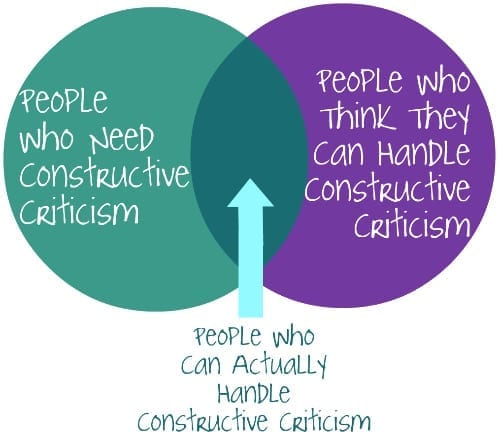
Is Criticism Ever Constructive?


Is there such a thing as constructive criticism? I heard someone make a forceful case to say that no, there isn't, saying it's never welcome and is not productive and the "sandwich" approach, where you praise, then criticize, then praise is not helpful ("Do you think I'm a fool for not noticing?").  Yaakov waited till he was on his deathbed to rebuke his children.  Moshe criticized the Jewish people only before his death and indirectly, with allusions.

Others disagreed.  Some people express appreciation when their mistakes are pointed out.  They don't want to repeat them! And even as it's uncomfortable to be on the receiving end of criticism, the question for the intellectually honest should be, "Is it true?"

And what about the mitzva to rebuke? And how can we do this mitzva when, long ago, the Gemara says (Erchin 16b) that our generation (meaning the time of the Gemara) no longer has anyone who can correctly deliver rebuke? Even more than that, there is no one in today's society who knows how to properly accept rebuke!

Apparently, the resolution lies in how the criticism is given, i.e. not as a personal attack, and not in a way that embarrasses the person.  Refraining from constructively criticizing someone is safe, for no feelings are hurt, but ultimately, is silence an act of Ahavas Yisrael?

Sep 26, 2011

I Was Touched


The person took my hand in their two hands and the blessings poured forth.  I was overwhelmed.  What an intense experience.  What heartfelt brachos.  More and more. 

What a beautiful thing it is to bless people, with all our heart.  Let's do it now, before Rosh Hashana.  Anytime. 

Kesiva v'chasima tova, shana tova u'mesuka, to all.

Dec 31, 2009

How About Our Iranian Brethren?


We have been urged to pray for Jonathan Pollard, for the boys in Japan, for Gilad Shalit and other missing Israeli soldiers, and Sholom Mordechai Rubashkin. How about our Iranian brethren?

The missing Jews are (add 12-15 years to the stated ages) :

Babak Shaoulin Tehrani, 17, of Tehran and Shaheen Nikkhou, 18, of Tehran arrested on June 8, 1994

Kamran Salari, 21, of Kermanshah and Farhad Ezzati, 21, of Kermanshah arrested September 21, 1994

Homayoon Balazadeh, 45, of Shiraz and Omid Solouki, 15, of Shiraz, Reuben Kohen-Masliakh,17 and Avrohom Kohen-Masliakh, 16, brothers from Shiraz, arrested on December 8, 1994

Nourollah (Nuriel) Rabizadeh-Felfeli, age unknown, of Kermanshah and Cyrus, 42 and Avraham, 47 Ghahramani (Kaharmany), brothers from Kermanshah, arrested on February 12, 1997

A 12th Jew, Yitzhak Hassid, 59, of Hamadan, last spoke with his sister in February 1997 and reportedly indicated he would try to leave the country. He disappeared February 15, 1997.

Between 1994 and 1997, 11 Jews, at the time ranging from 15 years of age to 59, were detained while attempting to cross the border from Iran into Pakistan seeking to be reunited with their families and in hopes of finding a secure future and a life of freedom. In addition, in February 1997, a Jewish businessman living in Tehran disappeared while visiting a provincial capital and has not been heard from since. The families of the disappeared have been virtually unable to get any information from the authorities as to the whereabouts of their loved ones.

Several eyewitnesses (former Iranian intelligence officials who are now living in the West) claim they have seen some of the missing in Iranian jails and others in a detention center, but to date nothing has been substantiated. Several years ago, two credible Iranian officials privately assured a family member in Iran that the men were alive and had been transported to a prison in Tehran. To date, no new information has emerged

In September 2006, Attorney Nitsana Darshan-Leitner of the Shurat HaDin Israel Law Center and New York Attorney Robert Tolchin, representing the families of the 12 missing Iranian Jews, filed a lawsuit against former Iranian President Mohammed Khatami.

The families of the 12 Jews in question say their loved ones were arrested by Iranian security authorities in the 1990s as they sought to escape from Iran across the border with Pakistan. At least some of them are believed to still be in Iranian prison. The Iranians have never acknowledged the Jews' arrest, nor have they given any word on their status or whereabouts.

Attorney Darshan-Leitner: "These individuals attempted to come to Israel at the encouragement and with the assistance of the Israeli government. It is therefore the responsibility of the Israeli government to do everything it can to gain reliable, specific information regarding their whereabouts in order to save them if we can, and give closure and end the suffering of the wives, children, fathers and mothers of those who were murdered by the Islamic Republic."

To do otherwise, the lawyer stated, means that the 12 Iranian Jews "have been abandoned.

If the prisoners were killed, we need to know and we need the bodies, the graves. There are women who are agunos for 16 years! Children are waiting for their fathers. These children were teenagers when their fathers disappeared; they remember them and are waiting for them to come back. There is no grave for them to go to; they can't say Kaddish. If we'd get the information these women wouldn't be agunos; they could be compensated by Israel for being widows of harugei malchut, people killed al kiddush Hashem.

Compiled with online information and with thanks to Mishpacha magazine for bringing this to our attention.