Showing posts with label chesed. Show all posts

May 30, 2017

About Henny Machlis a"h

I haven't even gotten halfway through the book and I'm writing a review. I've written about Henny Machlis before, here because the author of the book, Sara Yoheved Rigler, wrote articles about her on Aish.com years ago.

Rigler is an excellent writer and the subject of this book is a Brooklyn girl who went to Central and grew up modern-frum as most religious American Jews did in the 60's. But she wanted more and she undertook more careful observance of mitzvos. It's her personality though, her love for Jews, her ability to make anyone feel comfortable, her "good eye" that saw only good in people, that comes across most powerfully.

Even if we are not like Henny in personality, which I'm not, we can all adopt some aspects of her good middos. Whether it came easy for her or not, and some things she worked on, it wasn't all a gift, we can stretch, as she did, to do chesed and serve Hashem.

Jun 22, 2016

Rains of Blessing

The weather forecast yesterday was for a possible thunderstorm in the morning (which did not happen) and clear for the rest of the day.

It did not occur to me to check the forecast of the place I was going to, not far from where I live.  I traveled on a frum bus line and as we arrived at our destination it began to sprinkle.  Then drizzle. Then rain.  Then pour!

I was completely unprepared for this.  Although I had only a short distance to walk from the bus, it just wasn't possible without rain gear, which I did not have.  What should I do? I could not get off the bus at the last stop.  I said this to the bus driver, and the one person left on the bus said to me, "My daughter is coming to pick me up, do you want a ride?"

"Yes!"

Just getting in and out of the car was drenching but it was fantastic to have this chesed offered to me.  He had a younger daughter, not the driver of the car, dash out in the downpour (she had a hood, but still!) to check whether we were at the correct address.  Then he said I could use the umbrella in the car to get me the few feet to the door and his daughter came again in order to take the umbrella back from me.

A wonderful chesed, it was such a help, and I bless them.

May 31, 2016

Seat Shadchan

I boarded a crowded train and saw an elderly frum woman get on too.  She held on to a pole near me. She looked too elderly and fragile for that.

I looked over the possibilities and picked a man sitting in front of her who was busy with his phone.  I said, "Sir ..."

No response.

"Excuse me ..."

He looked up.  I gestured to the woman and said, "Maybe you'd give her ..."

He leaped up and said, "Sorry, I wasn't paying attention!"

The elderly woman was thrilled and she thanked me and thanked the man and sat down and opened her siddur.

Would I have done that for a non-Jewish person who looked in need of a seat? I think so.

I am grateful for having been given the opportunity to be a seat shadchan this morning.

Apr 9, 2016

Unique Chesed

As a follow-up to this post I wrote five years ago here about what makes our nation unique, here is something I read today:
 
A woman who runs a gemach was called by a businessman who told her the following.  He often bought sodas in a small store near his office.  One day, the Hindu storeowner asked him if he would take about one hundred extra items that the store could not use, saying, "I know you Jewish people like to help each other, and you have organizations to do this."
 
The Jewish man said, "Doesn't your religion have such organizations?"
 
The Hindu said, "Your people are known to have charity organizations to help a variety of people.  We don't have anything close to what you have."
 
The variety of chesed ideas that Jews come up with is extraordinary as any perusal of gemach listings will show.  Some unusual ones are:
 
Bar Review Materials Gemach
Bed rest crafts and activities gemach
Books on Twins Gemach: Books on expecting and raising twins
Boredom Busters Gemach: Books, magazines, tapes, CD's, and DVD's for homebound due to surgery or illness and for women on bedrest.
Camping Equipment gemach
EZ pass gemach
Ladder Gemach: 15 foot extension ladder
21 foot extension ladder
longer ladder is available
 
For more, see this community's listings and know that there are numerous communities around the world that have their own listings:
 

Apr 2, 2016

Love Yourself-Love Others?

Rabbi Dr. A. Twerski, in his work with addicts, knew a woman, Bonnie, who had stayed off alcohol for a year.  During the winter, her furnace broke and it took three days until it was fixed.

She slept in her freezing apartment for those three days.  When a friend heard about it, she was astonished and said, you could have called me or any of your friends and stayed with us.

She said, "I don't like to impose."

The friend mentioned this to Dr. Twerski who ran the 12 Step program that Bonnie was a part of.  He called her and said he was disappointed because he had planned on asking her to become a sponsor in the program.  She said, "You can call on me anytime; I'd be glad to help."

He said, "If you can't accept help, you can't give help."

This story was included in an Ami article about marriage to convey the idea that a wife who does not respect herself, who does not take care of her own needs, may do things for her husband but she'll do it with disdain and resentment. The rationale is, if you cannot admit and accept your limitations, you will look down on others for their limitations.

The points are made categorically, as though they are Accepted Truths, while I'm left wondering, really?

Bonnie's need was to be independent, not to impose, and Dr. Twerski turned this into a refusal to accept help, and he concluded that therefore, she could not help anyone.  She said she'd be glad to help and he would not even give her a chance.  Why not prove himself correct by letting her be a sponsor and seeing whether she could help someone or not?

One of the problems with this article is that it presents it as two choices: either you love and care for yourself or you don't.  Don't we all care for ourselves in some ways and neglect ourselves in other ways whether with sleep, exercise, how we eat, etc.?

And don't we accept help sometimes, in certain ways, but not in others? Did Bonnie never accept help ever, in any form?

And can it be proven that the more you take care of your own needs, the more you will respect the needs of your spouse and others?

Nov 22, 2014

In His Final Moments

We now mark six years since the murders of four Jewish men and two Jewish women, including the shliach and shlucha, in the Chabad house in Bombay.

The shliach's Gavriel Noach's father said that ZAKA told him that they can now tell him what they saw in the video from the Chabad house.

After Gavriel Noach was shot and was bleeding profusely, he crawled to where the talleisim were and placed them over the bodies of the others who had been killed. That was an act of chesed that he did, for kavod ha'meis, in his final moments.

R' Holtzberg also related how in India they cremate bodies and give a very hard time about releasing bodies, even to be buried out of the country. An Israeli had died in prison and Gavriel wanted to send the body back to Israel, but the Indian government refused.  Gavriel stood at the bed and said he is not moving until the body is released.

Yehi zichro baruch along with the other kedoshim.

Apr 27, 2014

A Project?


Are children a chesed project to their parents? Although parents do vast amounts of chesed for their children, they are still not viewed or referred to as a "project."  What is a project? I looked it up and found this definition: a planned piece of work that has a specific purpose (such as to find information or to make something new) and that usually requires a lot of time.  More simply, it's a planned undertaking.

Raising children is certainly a project, by that definition.  It's a job, the details are planned, there is a purpose, i.e. to raise a G-d fearing mentch, and it sure does take a lot of time.  It is usually a collaborative effort on the part of parents and the school.  And still, we don't refer to child rearing as a project.  Why is that?

I think it's because in business and science, a project is defined as a collaborative enterprise.  A school project might be a book report or historical research.  Projects are often or usually associated with work, school or volunteering. 
 
I suppose that is why I am surprised when people use the term "project" for taking care of an elderly family member, even those who do so lovingly.  Any thoughts about this?

Mar 17, 2014

Saying Yes is Also Saying No


I remember that it was a new thought for me when someone pointed out the ramifications of choice when it comes to chumras.  Saying "yes" to stringencies on Pesach, for example, means saying "no," to some extent, to an aspect of the mitzvah of simchas Yom Tov (unless a person is so elevated that they truly take joy in the restrictions). 

Saying yes to someone when asked to get involved, help out, do a chesed, means saying no to whatever else you may have done in that time.  That is why it is not just the merit of the chumra or the chesed that needs to considered, but what will be gained by doing it versus the possible loss.

In fact, halacha often states what takes priority.  Since Torah study takes precedence over every other mitzvah, is it ever set aside for another mitzvah? Yes.  For example, if there is nobody else to take care of a particular mitzvah. 

But it is not always that clear, particularly with optional activities.  Ask your LOR.

Feb 23, 2014

The Remarkable Story of Clara Hammer 1910-2010


I just finished reading this wonderful book, The Chicken Lady of Jerusalem: A Life of Giving -
The Remarkable Story of Clara Hammer 1910-2010.  I met her, but did not really get to know her.  Now, through the book, I got to know her.  What a lady!

Her idealism, her remaining frum when most of those around her did not, her passion, her strength of character, her love for Jews, for Eretz Yisrael, and for life, her exuberance.  A teacher and a doer.  She wasn't one to sigh over an unfortunate situation; she did something about it.

A short video interview of her: here

Jan 20, 2014

Mind Your Own Business?

* Someone says, "They say that we should let young couples make their own mistakes.  I think that's ridiculous! What sense is there in that? I was happy to be told how to avoid mistakes."

* Someone says, "I used to think it was a good idea, a chesed, to offer good advice.  My father says, don't offer advice to people unless they ask for it.  Why? Because unless they ask for it (and even if they do), they are not receptive to listening to it."

* Someone asks, "I have a tendency to tell people what to do because I really care and because often I am knowledgeable about a subject that the other person is not.  I always thought of myself as helpful, but a relative told me that my constant advice giving is annoying."

We live in a country in which independence is championed and "mind your own business" (MYOB) is a value.

And yet, what are we to learn from Yisro? He observed the situation of Moshe and the Jewish people in the desert and he critiqued it.  Without being asked.  (And he was an in-law, no less, who is warned to MYOB!) And then he gave advice.  And Moshe accepted it.

Should we emulate Yisro when we see something amiss? Or maybe the lesson to learn from this is to emulate Moshe who, when told that the way he was handling the situation was detrimental and was given advice, accepted it!

Dec 19, 2013

Socialist Chesed


In one of Mishpacha's Succos supplements, there was a piece about cost price catering in Gateshead, England.  A team of ladies does all the catering for local weddings and it can be as elegant or as simple as you are willing to pay for. 

I don't get it.

This chesed began 30 years ago when there were two caterers in the community who made a living (i.e. their service was not at cost price) from catering simchas.  A doctor in the community asked two women if they would be willing to arrange cost-price simchas to provide an option people could afford.  Once this became standard for every couple getting married in Gateshead, naturally the caterers went out of business.

So regardless as to what you can afford, you get a cost-price wedding catered by six ladies out of a list of volunteers.  Why would they want to cook for someone who can afford to pay for a caterer? I don't know.  Why was it a good thing that caterers were put out of business? I don't know.  Why is this done for everyone, no matter the need? Someone suggested it's because England is a socialist country so this is the mentality.

Toward the end of the article it says the waiters and waitresses respect the frum lifestyle but they can't always understand it.  One of these non-Jewish waitresses couldn't believe that no money is made off of catering these weddings because "as far as she's concerned, if people can't afford it, why are they having 300 guests at their wedding?" Uh, right. 

If weddings had fewer guests eating at the meal, we could bring the caterers back because weddings would be affordable.  The caterers would make a living, the volunteers could turn their attention elsewhere, and even the gentile waitress would see that Jews know to pay for what they can afford.

Oct 26, 2013

Joseph


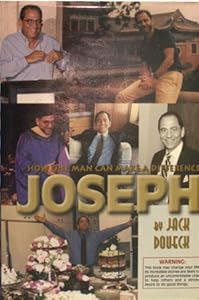
Joseph - How One Man Can Make a Difference by Jack Doueck (Sephardic Press) is similar to the Shloimie! book that I reviewed: here in that it's about a regular guy named Joseph Beyda, from the Syrian community in Brooklyn, who excelled in chesed (who also died young).  The stories told about him are exceptional.  He did chesed I would never dream up and he did chesed that I might consider but not actually do.

It was published years ago and I started rereading it.  It's inspirational reading, though the inspiration is not worth much if it doesn't get us to do chesed ourselves!

I've realized that a trait that many super-chesed doers that I've read about have in common is that they are outgoing people persons: Shloimie, Joseph, Reb. Chaya Sara Kramer (Holy Woman), Rebbetzin Basha Scheinberg (The Grand Rebbetzin).  An exception might be Mr. Herman from All for the Boss because what comes across about him is the desire to do what is right. 

So I got to thinking, what about those who are not people persons? Those who are more introverted and enjoy solitude?

Nobody is excused from chesed and caring for and helping people doesn't have to be done in an overtly outgoing manner.  There are doers of chesed who are more low-key and we can find the role models that we can emulate.

Oct 10, 2013

G-d's Calculations


I read a related idea to something I posted previously: here about how G-d has everything worked out based on our actions.  The idea can be read in its entirety as it appeared in Community magazine: here

The gist of it is, a sofer set aside some of his work time every month to voluntarily train two aspiring sofrim.  His colleagues said he was giving away valuable time in which he could be earning money.  He doesn't see it that way.  In his view, the time is well spent because it would otherwise be consumed by unpleasant things and he doesn't lose out at all.

According to his philosophy, if he is destined to lose work time every month, since this is part of life, he'd rather let his fellow Jews benefit from it.  "I am confident that these hours are lost time anyhow."

He and a colleague kept track of the time they spent working and the work time they ended up spending on other things.  The colleague was astonished to see that even with his volunteer work, the other sofer still worked more hours that month than he did, and that he lost time for various other reasons.

The conclusion: What is destined to be lost, one loses regardless, but you can utilize the loss of time for mitzvos and even save additional hours thereby!

Sep 15, 2013

Shlomie!


I started reading it on Rosh Hashana and finished it on Yom Kippur - I highly recommend the book Shlomie! (Artscroll).  He wasn't the usual rosh yeshiva, mashgiach, or rebbe that Artscroll biographies are about.  He was a balabus who lived in Flatbush who was a vilde chaya as a boy and went from yeshiva to yeshiva to yeshiva.  Today, he would be drugged for ADHD.  His good heart and yiras shomayim were always apparent, even when he was unable to sit in a classroom.

He went on to become extremely wealthy and a huge baal tzedaka.  His greatness was not merely in being able to write checks (though that is a great thing).  He loved people and loved making people happy.  He was constantly alert to how to help people in ways that had nothing to do with money.  Another aspect of his greatness was the fact that even though he could barely sit long enough to learn, he had regular learning sedarim and was machshiv Torah and talmidei chachamim.  He sought to grow spiritually and kept moving further away from a materialistic lifestyle.

He is an inspiration for those who were not a success in yeshiva and an inspiration to all when it comes to loving and pursuing chesed.  It's a book about a "regular guy," who with all his fun-loving geshmak-keit, was quite extraordinary.

Jun 27, 2013

Jews Helping Jews


In the spring issue of OU's Jewish Action magazine, there was a special section with articles about Hurricane Sandy.  The theme was how Jews from all walks of life came together with beautiful acts of chessed.  The link is: here

There is a follow-up article from the same magazine about how to foster achdus when we don't have crises to deal with: here

Jun 8, 2012

Loving Chesed


Have you ever met someone who is absolutely delighted to do a favor? What a wonderful experience!

I was waiting at a city bus stop for a bus that is notorious for its erratic and infrequent appearances when someone pulled up in their car and offered me, and another person waiting there, a ride.  The driver explained that ever since earning a license, it is their greatest pleasure to offer people rides.  They even deliberately drive by bus stops in order to seek out "customers." I'm not sure who was more thankful for the ride, me or the driver!

Nov 10, 2011

An Extra Kidney?


The frum media has had many heartwarming stories lately, about people donating kidneys to those in need, strangers to the donor.  Poskim have ruled that it is permissible to do this.

What I wonder about is the comment, often made by those promoting kidney donations, that perhaps this is the reason why Hashem gave us an "extra" kidney, so we could donate it.  This is predicated on the view that we don't need two kidneys and that we can function perfectly well with one.

This pronouncement does not sit well with me.  Is this really the case, that for millenia, billions of people were given two kidneys by Hashem, so that in our generation, a few people can donate a kidney? It is reminiscent of the medical wisdom of yesteryear in which tonsils and the appendix were considered superfluous and were frequently surgically removed without a compelling reason to do so. 

I'm sure it's true that as of now, with the medical knowledge we have today, it looks as though a person can manage just fine with one kidney, and since a person in dire need of a kidney is in a state of pikuach nefesh, poskim have ruled that a person can donate a kidney.  However, to say that Hashem created us with an extra, unnecessary organ? I'm not convinced.

Jul 11, 2011

Noticing the Good


The following two incidents happened within the span of two minutes  

Scene 1:
I saw a Chassid standing and talking to a non-Jewish black woman who was clearly in need of help in finding the address on the paper she held.  She was not dressed modestly, i.e. was sleeveless etc.

Scene 2:
A Chassid was about to enter a building when he saw an elderly person being pushed in a wheelchair by her aide.  He held the door open for them.

Two "random" scenes but nothing is random.  Let's remember these acts of kindness on the part of Jews who look obviously like Jews.  Oftentimes these small good deeds are overshadowed by rhetoric in which "ultra-Orthodox Jews" are stereotyped as rude.  There is plenty of good among us.  We need to be on the lookout for it and we'll see it.

Dec 10, 2010

You Are My Life

I listened to a powerful Chanuka shiur given by Rabbi Moshe Weinberger (Cong. Aish Kodesh of Woodmere) in which he focused on the Greeks' aim to "make them forget Your Torah." He said we don't forget that which is nogei'a (pertain, affects) our essence.

The Torah says, and it's one of the Six Remembrances, “shmor nefshecha me'od” (guard your soul very much) lest you forget the Torah - if Torah would be your soul, you wouldn't forget it.

How is it possible for there to be learned people who, when they go out to do business, steal? Don't they know the laws of stealing, gezel akum? The answer he gave is, it is because the learning is forgotten, i.e. it's not relevant to them, Torah is a subject, not lessons for life.

He told the story of a yeshiva bachur who borrowed a tape recorder and then broke it. The owner of the tape recorder wanted to be reimbursed but he said it was an accident and so he didn't have to pay. They asked their rebbi who brought them to the rosh yeshiva, R' Reuven Feinstein, who was appalled because they had been learning this topic in Gemara all zeman that if someone lends you something you are obligated to pay if something accidentally happens to it! He went to R' Moshe his father who said, you have to realize it has no relevance to them.

In our generation, he said, there is more learning than ever before and yet there is so little connection to what is learned. That's what Yavan is about, disconnecting us from the G-dly aspect of Torah and mitzvos.

The most touching part of his talk was when he gave an example of those things which affect your essence which you don't forget and he said that he and his sister felt every minute that they were the essence of their parents' lives, they weren't a “sideshow,” something that gets in the way of their parents' activities. His father said he could call any time, and one time he called because he was upset about something that happened at school. Unbeknownst to him at the time of his call, his father sent the customers out of the store and locked the store in the middle of the day and spoke to him for over an hour. His mother later said, couldn't you wait until 6:00? He apologized and his father said - What are you talking about (i.e. no apology is necessary)? Customers? Business? My leben is you.

Dec 9, 2010

"Just Say Yes" part 2

One year ago, I put up a post called "Just Say Yes" :

http://bikores.blogspot.com/2009/12/just-say-yes.html#links

to which this is a follow-up.  The prevalent view is that if we keep on giving we will become depleted, even burned out.  That seems like common wisdom indeed.  But is it true?

In the Artscroll biography of Rabbi Pam he was asked how to avoid burnout in chinuch.  Rabbi Pam did not relate to the question.  He so enjoyed teaching and derived tremendous satisfaction from it.  He regarded each student as a treasure.  He taught for decades and said this was the most enjoyable time of his life.  With that attitude, how could he grow tired of it?

So too with chesed, said the person I quoted in that other post.  If you do it for the right reasons, you gain in strength and don't lose out.