Fox News reported:
NASA Administrator Charles Bolden said in a recent interview that his "foremost" mission as the head of America's space exploration agency is to improve relations with the Muslim world. Please tell me he isn't serious!
Though international diplomacy would seem well outside NASA's orbit, Bolden said in an interview with Al Jazeera that strengthening those ties was among the top tasks President Obama assigned him. He said better interaction with the Muslim world would ultimately advance space travel. No explanations as to how this will happen when Moslems get zero credit for any advances in space travel made to date.
"When I became the NASA administrator -- or before I became the NASA administrator -- he charged me with three things. One was he wanted me to help re-inspire children to want to get into science and math, he wanted me to expand our international relationships, and third, and perhaps foremost, he wanted me to find a way to reach out to the Muslim world and engage much more with dominantly Muslim nations to help them feel good about their historic contribution to science ... and math and engineering ," Bolden said in the interview. Now this is post-worthy!
***
Never mind that Moslem contributions in recent centuries are negligible and the claims made about inventions associated with Moslem countries are so far in the past that many of them have no reliable confirmation. Let's put aside, for the moment, the extremely alarming attitude our president has towards the nations of the world and his groveling before our enemies and focus on just how far the self esteem movement has gone.
All those books, articles, and speeches on self-esteem that we have been subjected to, in and out of the frum world, are not just about positivity and confidence. It goes much, much further than that. It's all about "feeling good about yourself" just l'sheim feeling good. Can you imagine people in the shtetl or wherever Jews lived throughout the ages, being asked: Tell me, do you feel good about yourself? For that matter, l'havdil, any non-Jew past a certain age finds this sort of talk odd for this is very, very new talk.
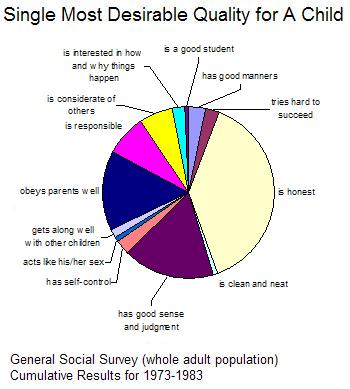
In days gone by though not so long ago (1973-1983), heading the list of qualities that American parents said they most valued in children were:
honesty
obeys parents well
has good sense and judgment
followed by being responsible, considerate and other similar values.
My guess as to what today's American parents would say as their #1 priority for their children is a toss-up between "their being happy" and "having self esteem." And how are children faring today as compared to a few decades ago? In the frum world we seem to be suffering from a multitude of problems that no, I don't think were merely hidden before and were there along to the extent we have them today. I think we are experiencing an explosion of destructive, counter-productive, undisciplined, un-Jewish behavior. I don't attribute all our problems to the promotion of self-esteem as opposed to G-d-esteem, but it definitely ranks up there as a major contributor to our lack of well-being
The focus in Avodas Hashem is, or ought to be, Hashem, not self. It's not about feeling good about yourself, but about whether Hashem is happy with you. Time to get back to basics.
Showing posts with label esteem. Show all posts
Jul 7, 2010
Dec 18, 2009
"And my soul should be as dust to all"
The buzz word for the past long while is self-esteem. Everybody agrees we all need it, most people don't think they have it, and there are endless numbers of books, tapes, lectures, workshops, and articles on the subject.
It says in Pirkei Avos, "Make His will as your will, so that He will make your will as His will; nullify (batel) your will for His will, so that he will nullify others' will before your will."
If you esteem your self, that is the opposite of bittul where you nullify your self.
Here's a definition: bittul is the negation of my will. My only desire is to fulfill what Hashem wants of me. There are levels of bittul like - I still have an opinion, but I put it aside and do what Hashem wants. A higher level of bittul ("v'nachnu ma " as Moshe and Aharon said) is when I don't have my own opinion. That's what it's all about, negating the "ich," I, the ego. It's the ego that gets in the way of all the good things we want to do. Hashem wants something but I want something else! Even anava (humility) is about "ich," because it's MY brains, MY talents, MY yichus, MY knowledge, MY good looks, etc. that I don't take credit for.
Don't get me wrong, anava is extremely important, needless to say! After all, Moshe was called the anav m'kol adam (more humble than anyone)! He did not credit himself with anything, even though he spoke to Hashem face to face, unlike any other human being.
Bittul is about getting AWAY from self. Who cares what I think, what I am? The emphasis is on the mission. On getting the job done. What job? The one given to us by Hashem.
When you do a mitzvah, you have to do it because Hashem commanded us to do mitzvos, not because you understand the mitzvah. You don't do it because you think it makes sense, or because you feel that it's the right thing to do. You do it solely because of Hashem. This is is called "naaseh v'nishma" - I accept the assignment; now tell me what it is.
Bittul means: I am nothing but Hashem's servant. Whatever He wants me to do, I do. I have no agenda of my own. My creation and continued existence is solely to fulfill His will. The Avos are described as the merkava-chariot of G-d. Just as a chariot (or a car) has no will of its own, and only goes where the driver directs it, so too the Avos lived only to fulfill G-d's will.
How sincere are we when we end Shemone Esrei each day with the words, "v'nafshi k'afar la'kol tihiye (and my soul should be as dust to all)?
My self confidence is only insofar as being confident that Hashem put me here solely to serve Him, and that He gave me the ability to do so. "Im ein ani li, mi li?" (if I am not for myself, who will be for me?) means only I can fulfill the role G-d assigned to me.
Bittul entails not thinking about yourself but thinking about G-d, about another Jew.
When we acknowledge that most of our misery comes from thinking about ourselves, we'll realize that it's a whole lot easier to have bittul than not to have it. Still and all, negating ourselves is a tough job, a lifelong avoda.
It says in Pirkei Avos, "Make His will as your will, so that He will make your will as His will; nullify (batel) your will for His will, so that he will nullify others' will before your will."
If you esteem your self, that is the opposite of bittul where you nullify your self.
Here's a definition: bittul is the negation of my will. My only desire is to fulfill what Hashem wants of me. There are levels of bittul like - I still have an opinion, but I put it aside and do what Hashem wants. A higher level of bittul ("v'nachnu ma " as Moshe and Aharon said) is when I don't have my own opinion. That's what it's all about, negating the "ich," I, the ego. It's the ego that gets in the way of all the good things we want to do. Hashem wants something but I want something else! Even anava (humility) is about "ich," because it's MY brains, MY talents, MY yichus, MY knowledge, MY good looks, etc. that I don't take credit for.
Don't get me wrong, anava is extremely important, needless to say! After all, Moshe was called the anav m'kol adam (more humble than anyone)! He did not credit himself with anything, even though he spoke to Hashem face to face, unlike any other human being.
Bittul is about getting AWAY from self. Who cares what I think, what I am? The emphasis is on the mission. On getting the job done. What job? The one given to us by Hashem.
When you do a mitzvah, you have to do it because Hashem commanded us to do mitzvos, not because you understand the mitzvah. You don't do it because you think it makes sense, or because you feel that it's the right thing to do. You do it solely because of Hashem. This is is called "naaseh v'nishma" - I accept the assignment; now tell me what it is.
Bittul means: I am nothing but Hashem's servant. Whatever He wants me to do, I do. I have no agenda of my own. My creation and continued existence is solely to fulfill His will. The Avos are described as the merkava-chariot of G-d. Just as a chariot (or a car) has no will of its own, and only goes where the driver directs it, so too the Avos lived only to fulfill G-d's will.
How sincere are we when we end Shemone Esrei each day with the words, "v'nafshi k'afar la'kol tihiye (and my soul should be as dust to all)?
My self confidence is only insofar as being confident that Hashem put me here solely to serve Him, and that He gave me the ability to do so. "Im ein ani li, mi li?" (if I am not for myself, who will be for me?) means only I can fulfill the role G-d assigned to me.
Bittul entails not thinking about yourself but thinking about G-d, about another Jew.
When we acknowledge that most of our misery comes from thinking about ourselves, we'll realize that it's a whole lot easier to have bittul than not to have it. Still and all, negating ourselves is a tough job, a lifelong avoda.
Subscribe to:
Posts (Atom)