Showing posts with label truth. Show all posts

Nov 26, 2016

And Another Moshiach Fantasy

 
Another Moshiach fantasy I have (see here for the first one) is that all Jews will have a glowing yud on their foreheads and all Amalekites will have a black ayin.  Lots of people with that yud will be surprised, sad to say, since so many Jews do not know they are Jews.  This could be because they were never told and had no reason to think so, because they were raised by non-Jews, because they did not know that having a Jewish maternal great-grandmother, grandmother, mother makes them Jewish.
 
A smaller group of people, those who thought they were Jewish but aren't, and who won't have a yud, will be surprised too.
 
The precedent for my Moshiach fantasy is Bereishis 4:15 where Hashem engraves a letter of His name on Kayin's forehead.  But I think this idea came to me from the Lights video here that I first saw 23 years ago on Chanuka.  It tells the Chanuka story and uses flying, golden letters of the alef-beis to represent Torah-true Judaism and Greek letters that drop with a clang to represent the Hellenist philosophy.
 
Identity, who we are, who we belong to.  That's the first step.  Once we know who we are, then we find out what we need to do.

May 23, 2014

The Yeshiva Myth

According to the "yeshiva world," the "Yeshiva Movement," as they call it, is attributed to the Gra because his talmid, R' Chaim of Volozhin (1749-1821) started a yeshiva. His yeshiva is considered the " Mother of All Yeshivos," as though yeshivos didn't exist before he started his own. This is untrue of course, as anybody who has read any historical accounts knows, and I'm not talking about the yeshivos in Sura and Pumbedisa in Gemara times or the yeshiva of Shem and Ayver ...

But this is part of the Litvish worldview, that they invented yeshivos and modern day learning, with the proper "derech," and all.

The Maharal (1520-1609) had a yeshiva.

Pinsk had a yeshiva. R' Shimon, a colleague of the renowned Maharshal (1510-1574), headed this yeshiva. After his passing, his son R' Refael succeeded him. When R' Moshe Yaffe became rav of Pinsk, he was also appointed head of the yeshiva."

There were yeshivos in Ostrohe, Brisk, Slutzk, Minsk, Vilna, Cracow, and Prague. [yes, I know some of these are Lithuanian towns. The point is they existed before the Volozhiner yeshiva.]
 
There were renowned yeshivos in Lublin in the time of the Maharsha (1555-1631) and the Maharam (1558-1616). The latter headed yeshivos in Lublin, Cracow, and Lvov, and had hundreds of talmidim.

The Maharshal (1510-1573) headed a great yeshiva in Lublin.
 
Likewise, later on, around the time of W.W. II, there were dozens of yeshivos in Hungary, Czechoslovakia, and Romania that had nothing to do with the Lithuanian yeshivos.
 
I found it very interesting that outside the yeshiva in Pressburg, the yeshiva of Pupa was the most organized and biggest yeshiva in all of Europe.

When the Nazis closed the yeshivos in Czechoslovakia, there was an overflow of boys on a waiting list for this yeshiva. In 1942 the yeshiva was already severely overcrowded; about 350 students were occupying rooms intended for 250. These were students 18 and older. (taken from an account of someone who learned there in 1942)

I grew up hearing about the Mir, Slobodka, Kelm, Baranovitch, and Radin but Pupa? Don't recall that it was even mentioned ...

I don't see how the structure and curriculum of the yeshiva of Volozhin, were unique. How did it differ from any of the yeshivos mentioned above? Why does it deserve the title "Mother of All Yeshivos?"

Jan 24, 2014

Kashering the Material


In the previous post, the message was Torah-true but the one conveying it was not up to par.  What about the other way around, when the message isn't coming from Torah but the one conveying it is a fine, frum Jew?

Many of us wonder about various approaches to life's issues that are taken by those in the helping professions.  Often, these approaches are not coming from Torah, but they are adapted for a frum audience.  For example, frum authors like R' Zelig Pliskin study secular self-help sources and then present the material for frum audiences with relevant examples.  Does this "kasher" the material? Do we say, there is wisdom there and we can and should benefit from that wisdom?

Perhaps the truth and the benefit of the model depends on how it was come by.  By that I mean, did the person already have an approach that he or she used, and only afterward try to see how it fit with Torah sources? In other words, it wasn't Torah that informed their decision.

Or, were they not invested in any approach but looked to see what tools "out there" might be useful to a Yid in his avodas Hashem, middos improvement, and general life.

For the most part, I read and hear of frum people who have already invested in a non-Jewish approach who then try and show how it "fits" with Torah. 

Jan 22, 2014

The Medium Must Match the Message


The story is told of a maggid (itinerant preacher) who gave inspiring speeches but did not live by the standards he preached.  However, people did not know of the indiscretions in his private life.

He was once invited to speak in Brisk.  His personal conduct became known to R' Chaim Soloveitchik who did not allow the man to speak.  The maggid tried to convince him otherwise saying, "But every thing I say is true! I quote the sources and the stories and points that I make are all appropriate to my audience!"

R' Chaim did not accept this reasoning.  "Even kosher meat, shechted by an expert shochet and soaked and salted according to halacha, becomes treif if cooked in a treife pot!"

This story left me wondering, when do we apply "kabel es ha'emes mimi she'omro" (accept the truth from the one who says it)? If what the maggid taught was true, how did his imperfect personal life which was not known to his audience, affect his message? Maybe because his words did not "emanate from his heart" and therefore, they would not enter the hearts of his listeners.

to be continued

Apr 16, 2013

The Truth of the Matter


After yesterday's bombing attacks at the Boston Marathon, one of the men who ran the race said he and a friend would try to see some of Boston, agreeing that they did not want the bombings to change their lives. “If you change your life, they win,” he said.

I've read some version of that sentiment in other contexts, usually following a terrorist attack in Israel, and it doesn't sit well with me.  Life should go on as usual when evil people seek to kill you?! It seems the epitome of irresponsibility and insensitivity to continue as though nothing happened.  If the attack was perpetrated by an enemy, it's an act of war and who can live life as normal in a war zone?

Maybe it would be more honest to say, my plans included touring Boston and although it's sad that people have been killed and maimed, canceling my plans won't help them.  Isn't it more about what I feel like doing today than about winning versus losing?

Jan 23, 2013

Where is the Emes?


What can we do about truthfulness when it comes to timing?

I spent time today, talking with someone about an event, the speakers, the performer, and above all else - the timing.  What time should the event start? How much time should the speakers be allowed to speak? What time should they aim to end the event? 

The main problem is that when a time is stated on an invitation or orally, people will most often not show up at that time. Why? Because they want to arrive when things are underway, not just beginning.  They don't want to sit around.  And in their experience, if an event is called for 8:00, nothing will be happening before 8:30. 

People who have tried showing up at a wedding reception for the time stated on the invitation have found that they have the waiters to talk to, no guests and no wedding party.  So those who don't want to waste their time hanging around, add a half an hour, an hour, or more, depending on the event.

In my recent experience, the times stated for the chuppa have been fairly accurate, so I don't see weddings as the major problem here.  If you can't or don't want to stay from the beginning to the end of a wedding, you choose the event (badeken, chuppa, meal, simchas chosson v'kalla) you want to attend and show up for that.

Also in my experience, if the event is a shiur, it is likely to start 15 minutes after the stated time.  The clue is, the shiur is called for 8:15.  That means, they want to start the actual shiur at 8:30 but want people to have a chance to settle down, eat, socialize a bit.

The problem lies mostly with events which are combinations of guest speakers and entertainment,  maybe an auction drawing too.  What happens is, those running it don't want to start until they have a decent crowd.  The decent crowd appears late.  Those who showed up on time or only moderately late (having known that of course they won't start on time) are kept waiting.  So those who are on time are penalized, i.e. made to wait, and the late-comers are the ones who are accommodated. 

We have role models of what we may consider "extreme" emes such as when Rabbi Yaakov Kamenetzky said he did not eat gebrokst (when that was his practice up until that time) in order to get out of a sticky situation on Pesach.  Not only did he not eat gebrokst that Pesach, but he kept up this practice from then on.  Why? Because if he said he did not eat gebrokst, he meant it.

If he was running an event, or guiding those who were, I can guess what he would say to do.  The problem is, nobody wants to be the first.  It can ruin my event if I actually start at the designated time, so I'd rather someone else be the one to start being punctual ...

Perhaps the only solution is to write, "Doors Open" at whatever time you choose.  Open the doors then, so you were truthful, and then give no further times.  People will show up "whenever," and you start your program when you want to.

Nov 22, 2012

The Truth of the Matter


R' Yosef Viener (rav in Monsey) saw chess players sitting for hours over a game. He commented about it and one of the players said to him, he thought he wasn't cut out to learn. He got married and became a day trader which required him to sit for 6 and ½ hours and concentrate (or he'd lose a lot of money). It was hard but he learned to do it and did it well.

Then he realized, a few years later, that he had been living a lie, convincing himself he couldn't learn Torah for hours. Money is a great motivator and he saw that money was important to him so he worked at it.  Learning wasn't important to him, so he gave up. When parents, teachers or the kids themselves say they aren't "cut out for learning," and say programs are needed for those "who can't sit and learn," maybe the truth of the matter is, Torah is not important enough to them to hold their interest.

Jun 27, 2012

Are Children as Astute as We Make Them out to Be?


I have read more than once, in articles on chinuch, that children sense the truth and that parents and teachers must be truthful with them because if they aren't, children will see through them. 

But is this true?

Aren't kids innocent, naive, gullible? Don't they believe in the Tooth Fairy? Haven't kids believed all sorts of things only to discover, when they got older, that they were misled? Why do some people think children have Truth Antenna?

Rather than tell parents and teachers to tell the truth because otherwise, children will sense they are lying, how about telling the truth because we need to be truthful! Midvar sheker tirchak!

Feb 17, 2012

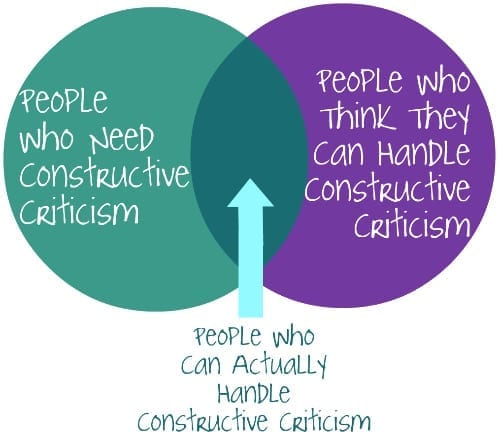
Is Criticism Ever Constructive?


Is there such a thing as constructive criticism? I heard someone make a forceful case to say that no, there isn't, saying it's never welcome and is not productive and the "sandwich" approach, where you praise, then criticize, then praise is not helpful ("Do you think I'm a fool for not noticing?").  Yaakov waited till he was on his deathbed to rebuke his children.  Moshe criticized the Jewish people only before his death and indirectly, with allusions.

Others disagreed.  Some people express appreciation when their mistakes are pointed out.  They don't want to repeat them! And even as it's uncomfortable to be on the receiving end of criticism, the question for the intellectually honest should be, "Is it true?"

And what about the mitzva to rebuke? And how can we do this mitzva when, long ago, the Gemara says (Erchin 16b) that our generation (meaning the time of the Gemara) no longer has anyone who can correctly deliver rebuke? Even more than that, there is no one in today's society who knows how to properly accept rebuke!

Apparently, the resolution lies in how the criticism is given, i.e. not as a personal attack, and not in a way that embarrasses the person.  Refraining from constructively criticizing someone is safe, for no feelings are hurt, but ultimately, is silence an act of Ahavas Yisrael?

Dec 14, 2011

Truth in Journalism


As a postscript to the previous post, I was dismayed to learn about the liberties taken with the truth by those who write for women's popular magazines.  Naive me actually believes when I'm told a story is true.  In Sybil Exposed it describes how certain journalists presented fiction as fact. 

The author of Sybil had doubts about the veracity of Sybil's abuse stories.  She actually went to the supposed scene of many crimes and discovered no evidence whatsoever for the abuse claims.  Worst of all, she read a letter Sybil had written to her psychiatrist, denying she had multiple personality disorder.  Her doctor, of course, said she was in denial. 

The author didn't know what to do with all this information.  Furthermore, the story as she knew it wasn't much of a story with a plot and dialogue. 

The ultimate solution? Fictionalizing the story and presenting it as the truth.  Subsequent to the book's becoming a major hit, the author and the pyschiatrist appeared on many shows talking about the book.  By that point, they had certainly convinced themselves that the book was true.

Leaves me wondering, what of what I read and think is true, is actually fiction? Some might say, it doesn't matter.  I've heard this before and been astonished as I've written in this post: click to read previous post

This world is described as Olam Ha'Sheker, a world of lies.  Nothing is as it appears to be.  Fiction can be masquerading as truth.

Jun 20, 2010

Intellect versus Emotion in the Courtroom

I heard a speech given by a lawyer who used to be a prosecutor and is now a defense attorney.  He said  that as a prosecutor you try to get the jury mad, to speak to their emotions, so they hopefully forget the actual laws involved.

This was said with no shame.  He was simply sharing how lawyers work and telling us that rather than focus on Truth and encouraging the jurors to concentratrate on the information being presented, they play on the court's emotions.  As the Zohar says, this is an alma d'shikra ( world of lies).