Showing posts with label education. Show all posts
Showing posts with label education. Show all posts
Nov 27, 2016


Oct 30, 2016
Taking a Tough Stance 2

Follow-up to this post: here
In the entertaining book, Ne Siyata D'Shmaya, the second to last story is about the author davening in a shul where bachurim were talking during kerias ha'Torah. He went over to them and gently told them it's forbidden to talk during kerias ha'Torah. They were silent for less than five minutes. He got up again and asked them to stop talking. They stopped for less than two minutes before resuming talking.
During the next Aliya he told them, the next time I hear you talking, I'm going to throw you out of shul. They looked at him scornfully, were quiet for a minute, then resumed talking.
He went behind them and grabbed the biggest bachur and shoved him out of shul.
Ten years later, he was back in that area and davened in that shul. He noticed a tall yungerman pacing the shul during kerias ha'Torah, ensuring there was no talking.
Unexpectedly, the man came over to him and shook his hand and hugged him. The author had no idea who he was. When davening was over, the young man said, "Ten years ago you threw a kid out of shul and he fell on a table and broke it. That kid was me and since then, I've been extremely careful never to speak a word during kerias ha'Torah. Plus, I make sure that no one in shul talks either."
So how long are parents, educators, and rabbis going to try the nicey-nice approach about derech eretz, tznius, decorum in shul, etc. without results before resorting to forcefully enforcing Shulchan Aruch and community standards?
Jul 2, 2014
Making a Mentch

I've heard of giving a child's teacher a gift for Chanuka and/or for Purim but today I heard something that goes way beyond that. A mother of a 6th grade boy said she sends money (she did not specify how much) and a specially worded card every rosh chodesh!
I referred to it as a bribe and she unabashedly agreed, it is definitely a bribe. She thinks the rebbi deserves it and needs it to handle her not so easy child. She also said that her father-in-law used to do this and although it's not the "mesorah" on her side of the family, with only one son, she can afford to do it.
On a related note, she said that this child's English teacher is not frum, although Jewish. He is a retired public school teacher. Surprisingly, after so many years of experience, he asked in the beginning of the year whether her child is normal! Now, her child can be silly as 12 year old boys can be, but other than that, he is quite a normal and bright child. She worked hard with her son over the school year and that, together with the fact that the teacher was really quite good and taught interesting things, made the child into quite a good student.
She had her son write this teacher a thank you note at the end of the year, in which he wrote about all he learned and how he became a mentch. This was given to the teacher with a gift. The teacher called and asked the mother, did you put your child on medication?
She said, not on your life! She would be the last person to do so, being quite opposed to even more ordinary medical practices. He asked her several times, because he could not believe that the change in her son was due to parental involvement, hard work, his good teaching, and the child maturing. I was surprised that a teacher with so much experience could not recognize a normal child from one who is not normal and couldn't believe that improvements can be made without drugs. When I said so, the mother explained it by saying he is coming from the public school system so his frame of reference is different.
May 27, 2014
Results or Effort?

Nowadays, when it comes to test results (and June is around the corner) the emphasis on results is often decried, with the new view maintaining that effort is what counts.
I disagree with this view. I think that's what tests are for, to see if you have mastered the material. Some master it more easily than others, but the point of tests is to measure mastery of the material. For example, either you pass your driving test or you fail. Effort doesn't count.
How much effort someone puts into mastering classroom material is another matter. Years ago you got marked for your mastery of a subject and there was a separate grade for effort or shekida though did you ever wonder how teachers were supposed to assess the amount of effort you put in?
On the one hand the mishna in Avos says, "it's not for you to finish the work, nor are you free to desist from it" which would support the position that effort is what counts, not results.
We also know that a good thought is reckoned like an action.
On the other hand, if a person tries to obtain matza (or an esrog etc.) for Pesach and doesn't manage to get any, although Heaven will give him credit for trying, he didn't do the mitzva and did not bring about the spiritual results of a mitzva! This supports the position that results are what count, and effort, though laudable, is not good enough.
Process or results ...
Dec 26, 2013
Kometz Alef Uh

There was a tribute to Rabbi Meir Pilchik a'h in Mishpacha magazine. He was a menahel and fundraiser associated with the Stoliner yeshiva but "his primary claim to fame was as an alef-beis rebbi in the Stoliner yeshiva."
The article went on to describe what a devoted and patient rebbi he was, and how he made Torah and Yiddishkeit sweet for the children. One detail that caught my attention had me wondering. It said that "he kept a looseleaf in which he detailed the progress of each child in his pre-1A class. He would monitor their mastery of keria, ensuring that no one left his classroom crippled for life with an inability to read."
This was over 40 years ago and there was no "special ed," no special ed training, and no keria programs. How did he, and Racoma Shain, author of All For the Boss, who also ensured that every child who left her class could read, manage this? Were the children different back then? Did something change? Was it the norm for all or the vast majority of children to learn how to read in an ordinary classroom, or were these particular teachers unusual?
How could we find out?
Apr 5, 2013
Untapped Potential
Dr. Najjar is a celebrated neurologist from Syria. He was not a good student and his parents and teachers considered him lazy. When he was ten he failed his tests and the principal suggested that he learn a trade. Education was very important to his father and so he sent his son to a different school.
A teacher in the new school took an interest in him and praised him and he did extremely well in her class. He eventually graduated top of his class in medical school and moved to the United States where he is presently an associate professor of neurology at the NYU Medical Center. Here is an example of his winning diagnosis: medical-mystery solved
So much is left unsaid in this short account. I wonder why a bright child would have done so abysmally in school when he was so smart and education was so important to his family. How many other children have the capability of doing well in school but don't, while giving their teachers and principal the impression that they are not intelligent enough? Is this rare or common?
A teacher in the new school took an interest in him and praised him and he did extremely well in her class. He eventually graduated top of his class in medical school and moved to the United States where he is presently an associate professor of neurology at the NYU Medical Center. Here is an example of his winning diagnosis: medical-mystery solved
So much is left unsaid in this short account. I wonder why a bright child would have done so abysmally in school when he was so smart and education was so important to his family. How many other children have the capability of doing well in school but don't, while giving their teachers and principal the impression that they are not intelligent enough? Is this rare or common?
Feb 22, 2012
What Happened to the Valedictorians?

I read:
"One researcher, after spending more than 15 years following the careers of high school valedictorians, concluded that most of them simply, "know how to do school. They are not the group to look for, for creative breakthroughs ... or for becoming notable leaders in a particular area."
Looking back, what happened to the students who had the highest marks? Where are they today? Are they more successful as adults than those who were average or weak students? By successful I mean: Are their lives objectively better than others? Do they have better marriages? better children? happier lives? more productive lives? I can't see that those with the top marks accomplished anything special in life, more than those with average grades.
Then again, what does happiness in life have to do with high marks in school? Perhaps it makes more sense to see whether those who got top marks did something with their academic abilities.
****
A woman wrote:
I was the class valedictorian. While I may not be considered hugely successful by my classmates standards, I gave up a rewarding job to stay at home and raise my kinderlach. That being said, the same tools of perserverance, attention to detail, knowledge and the love of learning that helped me be the valedictorian are what help me be the mother and community member that I am. I believe that one has to strive to be the biggest success they can be at each point in their lives. When in school, one has to excel to the best of their capabilities, when at a job the same, in raising yiddishe children the same idea follows. Just an insight from a valedictorn whom many view as not going on to be a success but who feels like one anyway.
Jan 16, 2012
Our Frum Therapists
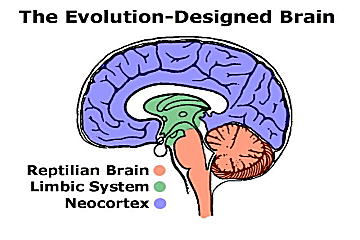
I was taken aback to read, in a frum publication, a reference to the "primitive brain" in connection with our self-defense mechanism, the flight or fight response. That is jargon used by those who espouse evolution who claim it's the oldest part of the human brain and a piece of brain anatomy that we share with reptiles. Not something I expect to see in a frum publication or hear from a frum person!
It reminded me of an article I read on a frum website in which the author referred to "our reptilian brain." In both cases, frum therapists whose books and articles are very popular in the frum world, show how they have been negatively influenced by their secular education.
It's disheartening because these authors have a lot of good things to say and it's too bad that we cannot rely on frum authors and frum publications and websites to provide us with untainted Torah-true material. It also belies the claim that frum men and women can study for a profession and somehow (magically?), because of their yeshiva education and allegiance to Torah, remain unsullied by anti-Torah ideas. We are encouraged to seek out frum counselors and yet, these same frum counselors may promote ideas that are antithetical to Torah. Caveat emptor.
Jun 21, 2010
Pill in His Coffee

Two months go by and the child is doing beautifully. One day, the father asks his son how things are going at school. The child said, terrific! Better than ever.
The father asks, is there anything you can attribute this to? The son says, I don't know but the only thing that is different is that every day, after davening, rebbi asks me to make him a coffee and to take this pill, so every day I make him coffee and put the pill in.
The question asked of R' Yitzchok Zilberstein was - does the teacher have to reimburse the father for the medication!
Should we laugh or cry?
How many parents are coerced into drugging their children in order to placate school staff? What a crime!
Subscribe to:
Posts (Atom)

 Posts
Posts

