In the same book, Brain Rules, that I referred to a few posts ago, I found the section on how to successfully memorize something interesting. What's needed is "spaced repetition."
It is better to space your review of the material than to squeeze all the repetitions together. As he puts it, "Learning occurs best when new information is incorporated gradually into the memory store."
It has been shown that we forget so much in the first hour or two after being exposed to something. The way to lessen this loss is by deliberate repetitions.
There is more information about this, if you are interested. It is something that ought to be taught in school so students know that cramming doesn't work well and so that they can best retain the information they work hard to memorize.
Showing posts with label brain. Show all posts
Showing posts with label brain. Show all posts
Aug 26, 2015


Aug 21, 2015
The Ten Minute Rule

In the book Brain Rules, there is a section on attention. The author states, contrary to popular belief, we cannot successfully multi-task. Yes, we can do things like walk and talk at the same time, because neither activity requires much of our attention, or just the talking does. And yes, a pianist can play different notes with their right and left hands simultaneously; they are trained to do that.
But we cannot successfully work on a writing assignment while playing a computer game and listening to music and talking/texting. This is because we cannot do those thing simultaneously and so we keep going from one activity to the next, each time having to refocus our attention. More mistakes are made and it takes much longer to complete a task this way.
Even more interesting to me is his 10 minute rule. The most common mistake made by teachers-professors-lecturers is conveying too much information with not enough time to digest the material. Medina, the author, asks every college class he teaches: When do you start looking at the clock in a class of medium interest. The answer is 10 minutes. Medina developed a model for giving a lecture which goes like this:
Every lecture consists of 10 minute segments. Each segment covers a single core concept which is explainable in 1 minute. A 50 minute class would teach 5 large concepts. The other 9 minutes of each segment is used to discuss the core concept in detail. Each detail needs to be easily related back to the core concept, and the teacher needs to spell this out because you don't want the audience to have to multi-task.
When 10 minutes are up, the speaker needs to do something to gain another 10 minutes of the audience's attention. He calls them "hooks." Hooks need to trigger an emotion: fear, happiness, nostalgia, incredulity. They need to be relevant, not just a random joke. Hooks need to either relate to the previous material or introduce the next 10 minute segment.
Next time you listen to a shiur-lecture-class, notice how you react. Does your interest start waning after ten minutes? How do your favorite speakers (the ones who teach, not tell stories) hold your attention?
Jan 16, 2012
Our Frum Therapists
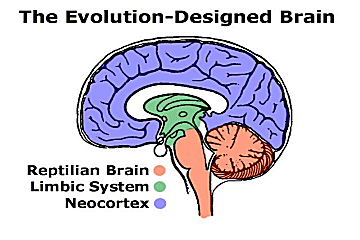
I was taken aback to read, in a frum publication, a reference to the "primitive brain" in connection with our self-defense mechanism, the flight or fight response. That is jargon used by those who espouse evolution who claim it's the oldest part of the human brain and a piece of brain anatomy that we share with reptiles. Not something I expect to see in a frum publication or hear from a frum person!
It reminded me of an article I read on a frum website in which the author referred to "our reptilian brain." In both cases, frum therapists whose books and articles are very popular in the frum world, show how they have been negatively influenced by their secular education.
It's disheartening because these authors have a lot of good things to say and it's too bad that we cannot rely on frum authors and frum publications and websites to provide us with untainted Torah-true material. It also belies the claim that frum men and women can study for a profession and somehow (magically?), because of their yeshiva education and allegiance to Torah, remain unsullied by anti-Torah ideas. We are encouraged to seek out frum counselors and yet, these same frum counselors may promote ideas that are antithetical to Torah. Caveat emptor.
Dec 16, 2011
How Rational Are We?
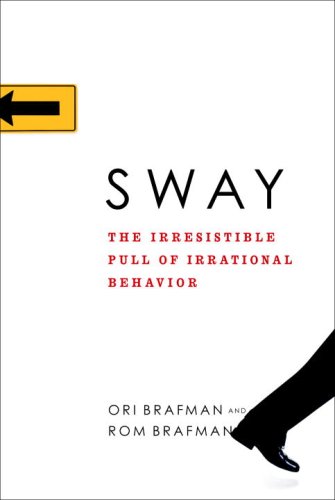
Sway is a quick and interesting read about why people, you and me, do irrational things. For example, the authors show how we do things against our best interests in order to avoid a loss which leads to far greater losses. Like a person whose stock value is dropping, who doesn't sell because he harbors the hope that it will go back up.
We draw conclusions about people or things and these conclusions color all subsequent information that we learn. For example, if we perceive something to be cheap, we treat it as inferior regardless as to its actual worth.
The part that was most worrisome was about how we evaluate people for jobs and longterm relationships. Seems we ask the wrong questions and even when we observe problems, we gloss over them if we have other reasons for favoring the person or thing that we are interested in. We need to do a lot of praying when it comes to shidduchim if we cannot rely on ourselves to make logical decisions! The book shows how vulnerable we are, even as we think we are being rational. It's a sobering look at ourselves.
Oct 19, 2010
The Brain That Changes Itself: Stories of Personal Triumph from the Frontiers of Brain Science

It demonstrates the various ways the plasticity of the brain can produce significant recovery of patients suffering from the most debilitating ailments, including paralysis from stroke, and autism. Prior to the acceptance of the idea that the human brain is surprisingly flexible and adaptable (plastic), most neuroscientists were of the belief that different sections of the brain specialized in specific tasks (localization), and these specialized areas became rigid and solidified early on in life in such a way that sufficient damage to each section would forever deprive the victim of its functionality.
There is a chapter on the remarkable recovery of a stroke victim, the amazing development of the Arrowsmith program and much more.
One caveat - there is one chapter that is X-rated in which he explains how people get addicted to pornography which you can skip.
Subscribe to:
Posts (Atom)

 Posts
Posts


